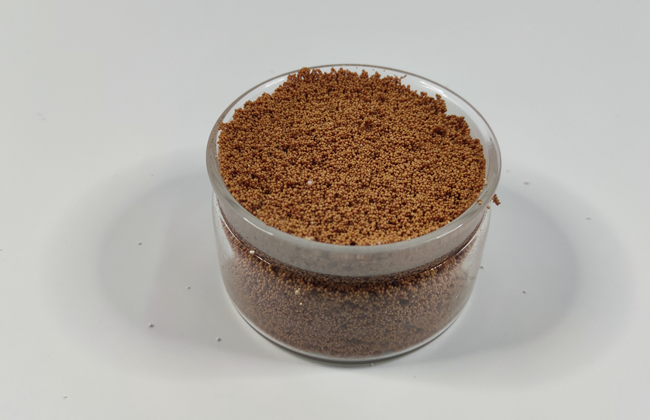
There is also a way of definition that a chelating resin is a resin with the special ability to select chelating groups and specific ions, because it has the ability to generate ionic bonds and adjust bonds to generate compounds. Later, it was vividly called chelating resin because its structure resembled a crab.
Atoms on the functional groups of the supernatant resin react with metal ions to form covalent covalent bonds, resulting in structurally stable chelates. Unlike the principle of ion exchange resins that adsorb metal ions, ion exchange resins are combined with metal ions due to electrostatic action. Therefore, the combination of chelating resin and metal ions is more stable, has stronger binding strength, stronger specific selectivity and wider application range. Heavy metals cannot be decomposed and destroyed, so they can only be transferred and changed in their physical and chemical forms to achieve the purpose of removing heavy metals. For example, in wastewater treatment, after treatment by chemical precipitation, heavy metals in wastewater change from dissolved ionic form to insoluble compounds that precipitate and migrate from water to sludge. After ion exchange treatment, the heavy metal ions in the wastewater are transferred to the chelating resin, and after regeneration, the heavy metal ions are transferred from the chelating resin to the regeneration solution.
Due to the polymer effect and special physical structure, chelating resins are more selective for metal ions than low molecular weight organic chelating agents. The adsorption properties of chelating resins mainly depend on the types of coordinating atoms and groups. The adsorption selectivity mainly lies in the properties of coordination atoms and metal ions that conform to the "soft and hard acid-base principle". Because the resin is insoluble in acid, alkali, solvent, etc., it is beneficial to separate the resin from the solution, and has excellent advantages in the fields of concentration, separation, analysis and recovery.