
Ion exchange resins are widely used in fields such as industrial water treatment, food refining, pharmaceutical purification, and hydrometallurgy. Their core functions include removing ionic impurities from solutions and separating different ionic components, thereby facilitating the purification of materials and ensuring that wastewater meets discharge standards. Improper selection can lead to a range of practical issues: failure to achieve the designed exchange capacity, fluctuations in effluent quality that exceed permissible limits, excessive consumption of regenerants, and persistently high long-term operating costs. In severe cases, the resin may suffer from physical breakdown or the loss of functional groups within just 1–2 years, necessitating a complete, premature replacement.
The industry generally recognizes three fundamental criteria for resin selection: sufficient exchange capacity, efficient regeneration performance, and stable, long-term durability. However, these criteria cannot be evaluated in a vacuum, independent of specific operating conditions. In particular, selection should not be based solely on a product’s nominal total exchange capacity—many resins with impressive nominal specifications often fail to deliver the expected performance under actual operating conditions.
Clarify The Target Ion And Choose The Right Resin Type
The first step in the selection is to clarify the types of ions that need to be removed or separated in the solution, and then select the three corresponding categories.
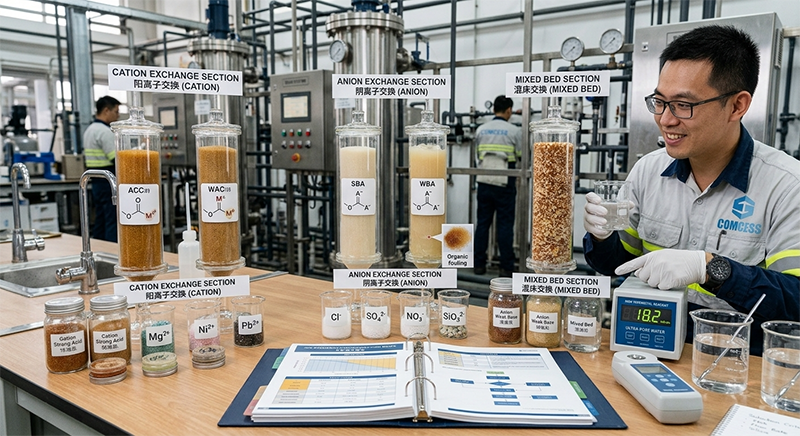
The cation exchange resin has acidic functional groups inside, which can adsorb positively charged cations in the solution, such as Ca2+, Mg2+, Na+, which are common in water bodies, and heavy metal ions such as copper, nickel, and lead in industrial wastewater.According to the strength of the functional group acidity, it can be divided into two categories: strongly acidic and weakly acidic: strongly acidic resins are suitable for a wide pH range and are the mainstream choice for industrial water softening and boiler supply water desalination; weakly acidic resins have higher exchange capacity and less acid consumption for regeneration, and are more suitable for high-concentration cation and alkalinity removal scenarios. Typical applications include hard water softening, pure water preparation, yangbed section, electroplating wastewater heavy metal recovery, etc.
Anion exchange resin has alkaline functional groups, which are used to remove negatively charged anions such as Cl⁻, SO₄2⁻, NO₃⁻, silicate, etc., which are correspondingly divided into two categories: strongly alkaline and weakly alkaline.Strong alkaline anionic resin can remove all anions, including weak acids, and is the core material for desalination systems and ultrapure water preparation; weak alkaline resin has better resistance to organic pollution, and is often used as a pre-process to adsorb strong acid roots, and then combined with strong alkaline resin to complete in-depth treatment. It is mostly used in desalination anion bed section, electronic-grade ultrapure water preparation, fluorine-containing and nitrifying nitrogen wastewater treatment and other scenarios.
The mixed bed resin is to evenly mix the cation and anion resins in proportion and fill them in the same exchange column, which is equivalent to countless groups of positive and negative resins working in series, which can simultaneously remove the positive and negative ions in the solution.The water resistivity of ordinary primary desalination systems is usually 0.1-1MW-cm, and the ultrapure water standard of 18.2MW・cm can be reached after the mixed bed is refined. It is an essential process for the preparation of high-purity water in electronics, photovoltaic, pharmaceutical and other industries.
It should be noted that the selectivity of the resin is determined by the type of its own functional group and the affinity of the resin with the target ion.If the process goal is selective separation rather than full desalination, the affinity ranking of the target ion and the coexisting competing ion must be considered at the same time, otherwise it is very easy to have the problem that the target ion has not yet reached the standard, and the resin has been filled with other competing ions.
Evaluating Key Performance Indicators of Ion-Exchange Resins
Performance indicators directly determine a resin’s treatment efficacy, operating costs, and service life, serving as the primary criteria for selection.
Exchange capacity is the most critical performance metric, though it is essential to distinguish between "total exchange capacity" and "operating exchange capacity." Total exchange capacity refers to the maximum amount of exchangeable ions per unit mass or volume of resin—a value measured under ideal laboratory conditions and determined by the density of the resin's functional groups. For instance, the widely used 001×7 strong-acid cation exchange resin in China is required by national standards to have a total exchange capacity (on a dry basis) of at least 4.50 mmol/g and a volumetric total exchange capacity of at least 1.80 mmol/mL. In contrast, operating exchange capacity represents the effective capacity available under actual operating conditions—typically only 60%–80% of the total exchange capacity. It is influenced by factors such as influent ion concentration, flow rate, the degree of regeneration, and bed depth; it is a core parameter that directly dictates water output and regeneration cycles.
The degree of cross-linking also significantly impacts both exchange capacity and overall resin performance. A lower degree of cross-linking results in larger pores, allowing functional groups to interact more easily with ions and yielding a higher total exchange capacity; however, this comes at the cost of reduced mechanical strength and chemical stability. Conversely, a higher degree of cross-linking creates a more robust resin framework with greater impact resistance, but the resulting smaller pores may prevent some internal functional groups from participating in the reaction, leading to a slight decrease in exchange capacity. When selecting a resin, one should not rely solely on the total exchange capacity listed in product manuals; instead, the focus should be on comparing the operating exchange capacity under specific, relevant operating conditions.
Selectivity is a key indicator for determining treatment efficacy in systems containing multiple types of ions. Resins exhibit varying affinities for different ions, preferentially adsorbing those for which they have a stronger affinity. For example, a typical strong-acid cation exchange resin follows this order of affinity for common cations: Ca²⁺ > Mg²⁺ > K⁺ > Na⁺ > H⁺. This principle forms the basis for the effective removal of calcium and magnesium ions during water softening. If the concentration of competing ions in the influent is significantly higher than that of the target ions, standard resins may struggle to effectively adsorb the target ions present at lower concentrations. For instance, in low-concentration nitrate-containing wastewater, if the sulfate concentration significantly exceeds that of nitrate, conventional strong-base anion exchange resins will preferentially adsorb sulfate ions, causing nitrate to break through the resin bed rapidly. In applications such as precious metal recovery or specialized separation processes, selective resins—engineered with specific functional groups—can achieve targeted adsorption. These resins exhibit a much higher affinity for specific ions than for coexisting impurities, offering significant practical value.
Regeneration is a critical, recurring phase in ion-exchange processes. Its efficiency directly dictates chemical consumption, operational costs, and resin lifespan, and is closely linked to the parameters of the regenerant and the specific regeneration technique employed. For example, when using strong-acid cation resins for softening, co-current regeneration typically results in a salt consumption 2–3 times the theoretical value, whereas counter-current regeneration can reduce this to 1.5–2 times—a difference that leads to substantial savings in chemical costs over the long term. If regeneration efficiency is poor, a resin cannot fully recover its capacity; this results in shorter operational cycles and increased chemical usage, driving up long-term costs. Therefore, resin selection must align with the regeneration conditions available on-site. If a facility is equipped only with a basic co-current regeneration system, there is no need to select high-end resins that rely on counter-current regeneration, as this would simply lead to a waste of performance capabilities.
The physical and chemical stability of a resin determines its service life and must be compatible with the complex operating conditions of an industrial environment. Physical stability is primarily assessed through resistance to osmotic shock and mechanical strength; the conversion of a resin between different ionic forms causes it to expand and contract. Resins with poor resistance to such stress are prone to fragmentation after repeated cycles of expansion and contraction—in industrial operations, the annual fragmentation rate should be kept below 3%. Chemical stability concerns a resin's resistance to temperature, pH fluctuations, and oxidation. Standard styrene-based strong-acid cation resins generally have a maximum operating temperature of 120°C, while strong-base anion resins are limited to 60°C in the chloride form and 40°C in the hydroxide (OH) form; exposure to higher temperatures accelerates the degradation of functional groups. Oxidizing agents, such as residual chlorine in the influent, can cause the resin’s chemical bonds to break; therefore, the residual chlorine concentration must be maintained below 0.1 mg/L. In water treatment systems with stable operating conditions, high-quality resins can last for 3–5 years, whereas under harsh conditions, their lifespan may be reduced to 1–2 years.
[With optimized cross-linking structures, COMCESS resins ensure exceptional operating exchange capacity and long-term stability even under demanding working conditions.]

Verify Chemical Compatibility And Operating Conditions
After determining the resin category, it is necessary to check the chemical compatibility in combination with the characteristics of the solution to be treated and the on-site operating environment to avoid the rapid failure of the resin due to uncomfortable working conditions.
The pH value is the primary working condition parameter to check, and the resin exchange capacity is directly related to the pH of the solution.The dissociation of functional groups of strongly acidic and alkaline resins is less affected by pH and has a wide range of applications. It can usually work normally in the range of pH 1-14; weakly acidic resins can only fully dissociate and exert exchange capabilities in environments with pH>5, while weakly alkaline resins are suitable for acidic and neutral environments with pH <9.If the pH of the solution exceeds the applicable range of the resin, its exchange capacity will decrease significantly or even fail completely.
The operating temperature directly affects the aging rate of the resin, and each resin has a corresponding maximum operating temperature threshold.There may be no obvious abnormalities in short-term over-temperature, but long-term high temperature will accelerate the aging of the resin skeleton and the loss of functional groups.In addition to the operating temperature, the temperature of the regenerated liquid also needs to be controlled. For example, the sodium hydroxide solution used for the regeneration of anionic resins, the temperature is too high, which will accelerate the degradation of strong alkali groups. It is usually recommended to keep the temperature of the regenerated liquid at 30-40℃.
The chemical concentration of the solution will also affect the performance and life of the resin.High concentrations of acid and alkali will corrode the resin skeleton, and high concentrations of salt solutions will increase the osmotic pressure and intensify the expansion and contraction of the resin.If the solution contains oxidants and organic solvents, the compatibility must be confirmed in advance-ketones, esters, high-concentration ethanol, etc. may cause the resin to swell or even dissolve the skeleton, and conventional resin treatment cannot be used directly.
Organic pollution and suspended impurities are common causes of resin failure.Suspended solids and colloids in the water will clog the gaps in the resin bed, causing increased pressure drop and uneven water distribution; macromolecular organic matter such as humic acid will be adsorbed by the anionic resin, clogging the internal pores, causing irreversible organic pollution, resulting in continuous attenuation of exchange capacity.For inferior raw water with high organic content, a complete pretreatment process is required, or a macroporous and anti-pollution resin is directly selected, and ordinary gel resin cannot be used directly.
Matching Resin Bed Height And System Design
The resin selection needs to be matched with the design of the entire ion exchange system, otherwise no matter how good the performance is, it will not be able to give full play to it.
The depth of the bed directly determines the ion exchange contact time and the water quality of the effluent.If the bed is too shallow, it will cause insufficient ion contact to penetrate, and the water outlet will exceed the standard in advance; if the bed is too deep, it will increase the water flow resistance, push up the energy consumption of the water pump, and lengthen the regeneration time.Different processes in the industry have corresponding common bed height experience values: the bed height of conventional softening systems is mostly 0.8-1.5m, the first-level desalination Yangyin bed is usually 1.2-2.0m, and the mixed bed finishing treatment is generally 1.0-1.5m. The specific height needs to be adjusted in combination with the water quality of the water inlet, the operating flow rate and the water outlet requirements.
The operating flow rate determines the contact time between the solution and the resin. Too fast flow rate will lead to incomplete exchange and decrease in effluent quality; too slow will reduce the utilization rate of equipment.The flow rate of different scenarios varies greatly: the softening system is 20-30m/h, the desalination system is 15-25m/h, and the mixed bed finishing treatment can reach 40-60m/h.High-precision processes such as heavy metal recovery and special separation need to further reduce the flow rate to ensure adequate adsorption.
The operating pressure drop is positively related to the resin particle size, bed height, and flow rate. Too high pressure drop will increase energy consumption and cause resin compaction and crushing.The pressure drop of conventional fixed bed is generally controlled at 0.1-0.2MPa, and the selection needs to be combined with the matching parameters of the on-site water pump head.
The adaptability of the regeneration system directly affects the performance of the resin, and the on-site regeneration process (downstream, countercurrent, floating bed) and the preparation capacity of the regeneration agent must match the resin characteristics.For example, the countercurrent regeneration process has high requirements for the uniformity of resin particle size, and it needs to be matched with a uniform resin to ensure the regeneration effect; if the site is only equipped with a simple downstream regeneration device, the benefits of choosing a uniform resin are very limited.In addition, the parameters of the regeneration solution concentration, contact time, backwash strength, etc. need to be set according to the resin characteristics, and the old process parameters cannot be directly copied.
After completing the parameter matching, the operating capacity calculation needs to be carried out to determine the final resin filling amount.According to the ion concentration of the water inlet, the hourly treatment capacity, the target water quality of the water outlet, and the set regeneration cycle, calculate the total amount of ions to be adsorbed in a single cycle, and then divide by the working exchange capacity under the corresponding working conditions to obtain the required resin volume.Note that the working exchange capacity must be used for accounting. If the full exchange capacity is misused, the filling capacity will be too small, which will cause problems such as frequent regeneration and substandard water output in actual operation.
Selecting Resin Types Based on Industry-Specific Applications
Given the significant variations in the substances being treated, water quality standards, and regulatory compliance requirements across different sectors, the choice of resin must be tailored to the specific needs of each industry.
Water treatment represents the largest application area for ion-exchange resins, encompassing processes such as the softening of boiler feed water, the production of industrial-grade pure water or ultrapure water, and the treatment and reuse of industrial wastewater. For standard boiler water softening, strong-acid cation exchange resins are typically used to remove calcium and magnesium ions, thereby preventing scale formation. The production of industrial pure water often employs a demineralization process using a combination of strong-acid cation resins and strong-base anion resins. For the electronics and photovoltaic industries, which require ultrapure water, an additional "mixed-bed" polishing stage is necessary, capable of achieving an effluent resistivity of up to 18.2 MΩ·cm. In wastewater treatment, anion exchange resins can be used to recover hexavalent chromium from electroplating wastewater, while cation or chelating resins can be employed to recover valuable metals—such as copper or nickel—from mining wastewater, simultaneously ensuring that the treated effluent meets discharge standards.
In the food and beverage industry, a primary requirement is that resins must comply with safety standards for materials intended for food contact. They must also effectively perform functions such as deashing (demineralization), decolorization, and purification. Typical applications include the deashing and decolorization of syrups in the sugar industry, as well as the desalting and decolorization processes involved in the production of xylose and xylitol. The use of industrial-grade resins is strictly prohibited in these applications; instead, products must hold food-grade certification and meet safety standards regarding extractable substances to ensure that the safety and flavor of the final food or beverage products are not compromised.
The pharmaceutical industry imposes exceptionally high standards for resin purity and biosafety, requiring compliance with pharmacopeia standards to ensure no harmful impurities are introduced. Resins in this sector are frequently used for the decolorization and purification of organic acids, the extraction and refinement of pharmaceuticals, and the separation and enrichment of active ingredients from traditional Chinese medicines. When selecting resins for these purposes, critical factors include the level of organic extractables and chemical compatibility, as well as adherence to relevant pharmacopeia standards. For high-end pharmaceutical applications, resins must also meet requirements for being pyrogen-free and endotoxin-free. In hydrometallurgy, process solutions are typically characterized by complex compositions, high acidity, and a high concentration of impurities. This places stringent demands on the selectivity and corrosion resistance of ion-exchange resins. Such resins are widely used for the separation and enrichment of precious metals, the selective recovery of valuable metals, and the separation and purification of rare-earth elements. Because conventional ion-exchange resins often lack sufficient selectivity in complex systems, specialized chelating resins or adsorption resins are typically employed; these utilize specific functional groups to form coordination bonds with target metal ions, enabling highly selective adsorption. When selecting a resin, key factors to evaluate include adsorption capacity, selectivity, resistance to acids and bases, and the ease of regeneration and elution.
[COMCESS provides tailored resin solutions across all applications—from electronic-grade ultrapure water to food refining and hydrometallurgy—balancing strict compliance with maximum cost efficiency.]
Calculating Total Life-Cycle Operating Costs
A common pitfall in resin selection is prioritizing the lowest purchase price. In reality, the initial procurement cost represents only a small fraction of the total life-cycle cost; calculating the total operating cost over the entire life cycle is the only way to determine which resin offers the best value.
A comprehensive life-cycle cost analysis should cover five core categories: First, the initial procurement cost, which includes the purchase price of the resin itself, as well as transportation and loading expenses for the initial fill. Second, replacement costs, which are directly related to the resin’s service life and annual replacement rate; a low-cost resin might require a complete replacement every 1–2 years, whereas a high-quality resin could remain stable for 3–5 years, resulting in a lower annualized cost. Third, the cost of regeneration chemicals—a major long-term operational expense. For instance, in water-softening systems, a twofold difference in salt consumption for regeneration can lead to annual salt costs that far exceed the price of the resin itself; the same applies to water, acid, and alkali consumption, with differences becoming significant over time. Fourth, energy (electricity/water) consumption and labor/maintenance costs; resins that cause high pressure drops increase electricity costs for water pumps, while resins prone to fragmentation or fouling require frequent backwashing and replenishment—all of which drive up daily operational and maintenance expenses. Fifth, hidden costs, such as a rapid decline in resin capacity, which necessitates more frequent regeneration and leads to reduced output, ultimately impairing the operational efficiency of the entire production line.
Resins with a higher initial purchase price often offer greater working capacity, lower consumption of regeneration chemicals, and a longer service life, resulting in a lower total cost of ownership over the long term. When selecting a model, do not focus solely on the quoted unit price; instead, calculate the total operating cost over a 3–5 year period before making a comparison.
Selection Of Pit Avoidance And Supplier Selection
In the actual selection work, procurement and technical personnel often fall into some common misunderstandings, which need to be avoided:
The model is only selected based on the full switching capacity.The full exchange capacity is the value under the ideal conditions of the laboratory, and the working exchange capacity in the actual working conditions is the core reference.Many resins with high nominal capacity have low crosslinking degree and poor mechanical strength, and they are quickly broken after being put into use, but the actual total exchange volume is lower.
Do not ignore competitive ions and selectivity.In scenarios where the target ion concentration is low and the impurity ion concentration is high, ordinary resins cannot effectively adsorb the target ions, so special selective resins must be selected.For example, if selectivity is ignored when removing nitrates, the problem of sulfate filling the resin and direct penetration of nitrate can easily occur.
Do not ignore the pH and temperature limits.If the temperature of the process solution is too high or the pH fluctuates greatly, the selection of ordinary resins will cause rapid degradation of functional groups and will fail in just a few months.
The material does not match the on-site regeneration conditions.High-end resins have high requirements for the regeneration process. If the on-site equipment cannot be met, it will lead to insufficient regeneration and the resin properties cannot be fully utilized, resulting in waste of costs.
It is recommended to purchase on a large scale without water quality analysis and small tests.The composition of industrial wastewater and complex material systems fluctuates greatly, and the selection of models based on experience alone is extremely error-prone.The safe process is to first take water samples for static adsorption tests, and if necessary, verify the operation effect through a small test device, and then purchase in bulk.
The performance stability and follow-up technical support of the resin depend to a large extent on the ability of the supplier. The selection can be investigated from the following dimensions: first, the integrity of the product system, covering the full range of resins, can be adapted to the needs of multiple industries and processes; second, the technical support ability, can provide targeted selection solutions based on water quality and working condition parameters, rather than simply selling products; third, the quality stability, consistent batch parameters, perfect production control and quality inspection system; fourth, industry application experience, familiar with the corresponding fields of compliance requirements and process pain points; fifth, after-sales service capabilities, can provide on-site technical support such as filling, debugging, and troubleshooting.
COMCESS has a full range of ion exchange resin products, covering many industrial fields such as water treatment, food and beverage, pharmaceutical, hydrometallurgy, etc., and is equipped with special models for different scenarios; its technical team can complete the selection and matching according to customer water quality analysis and process parameters, and provide full-process support from small trial testing to on-site commissioning to help customers choose resin products that are suitable for their own working conditions.
Conclusion
There is no absolute optimal solution for the selection of ion exchange resins, and adaptation to working conditions is the core.The core judgment dimensions are target ion selectivity, work exchange capacity, regeneration adaptability, chemical stability and industry compliance. The selection should not be based on nominal parameters or purchase unit price alone. It is recommended to provide complete water quality, working conditions and effluent requirements, and submit them to professional suppliers for evaluation. If necessary, the final decision will be made after a small test certificate.

.png)
