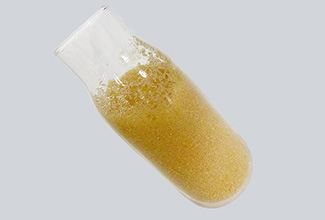
In the global starch sugar and starch deep processing industry, ion exchange resins are the core functional materials that determine the purity, color and quality stability of finished products.According to industry statistics, in the downstream applications of global food-grade ion exchange resins, starch sugar and related deep processing fields account for more than 35% all year round. It is the largest application scenario, covering maltodextrin, fructose syrup, crystallized glucose, functional oligosaccharides and sugar alcohol products.
For overseas starch sugar production enterprises and EPC engineers, the ion exchange unit is not only an essential process for products to meet international food standards, but also the sector with the highest cost ratio in the refining process.From the process positioning, core values, cost composition to the main points of selection, this paper systematically disassembles the general application logic of ion exchange resins in the starch sugar industry.
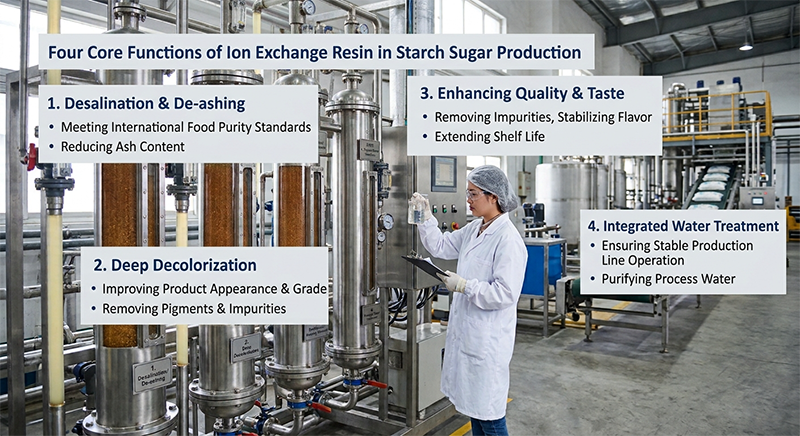
The 4 Core Roles Of Ion Exchange Resins In Starch Sugar Production
Desalination And Desalination to Meet International Food Purity Standards
During the starch hydrolysis process, the metal cations such as calcium, magnesium, sodium, and iron brought in by the raw materials, as well as sulfate, chlorine, organic acid and other anions, will form product ash, which affects the taste and storage stability.
- The use of strong acidic cation exchange resin to adsorb and remove metal cations, greatly reducing the ash content of the product;
- Adsorption of weak base/strong baseanion exchange resin to remove anions and organic acid roots;
- Further deep desalination through the back-end mixed bed fine treatment can control the ash content below 0.1% to meet the purity requirements of high-end food and medicinal grade products.
Deep Decolorization To Improve Product Appearance and Grade
The brown pigments (Maillard reaction products, caramel color), colloidal substances, protein macromolecules in the hydrolysate, and activated carbon are difficult to completely remove small molecular pigments.Special macroporous adsorption resin or decolorizing anionic resin can selectively adsorb small molecular pigments to change the sugar liquid from yellow-brown to clear and transparent. It is an essential means for the production of high-whiteness crystalline glucose and colorless transparent fructose syrup, which directly determines the market grade and pricing of the product.
Remove Impurities And Improve Quality, Stabilize Taste And Shelf Life
The resin can simultaneously remove nitrogen-containing impurities, odor components, microbial metabolites, etc., effectively improve the purity of the syrup taste, and avoid quality problems such as sourness, odor, and turbidity of the finished product; at the same time, it reduces the fouling of subsequent evaporation and crystallization equipment, and extends the service life of the equipment and the shelf life of the product.
Supporting Water Treatment to Ensure The Stable Operation of The Production Line
In addition to the refining of the main process sugar liquid, the starch sugar factory also uses a lot of ion exchange resin to treat the water used in the production of supporting products.:
- Boiler Feedwater Softening: Removes calcium and magnesium hardness to prevent boiler scaling and ensure safe, stable operation of the steam system.
- Pure / Ultrapure Water Preparation: Used for ingredient blending, equipment cleaning, and resin regeneration processes to avoid secondary contamination of the sugar solution.

Typical Application Configuration Of Ion Exchange Resin In Starch Sugar Production Line
The world's mainstream starch sugar production lines generally adopt the three-stage fixed bed process of “Yang column-yin column-mixed bed", and large-scale chemical plants mostly use continuous ion exchange (simulated mobile bed) system. The specific configuration and selection classification are as follows:
|
Process Stage |
Resin Type |
Core Function |
Selection Grade & Performance Positioning |
|
Primary demineralization |
Food-grade gel-type strongly acidic cation exchange resin |
Remove metal cations such as calcium, magnesium, and sodium; remove ash |
Standard: High exchange capacity general-purpose grade, suitable for low-impurity raw materials such as corn starch; High-performance: High fouling-resistant uniform-particle grade, suitable for high-impurity conditions such as cassava/palm starch, with longer operating cycles |
|
Secondary demineralization and decolorization |
Food-grade macroporous weakly basic anion exchange resin |
Remove organic acid anions and anions; adsorb small-molecule pigments |
Standard: General-purpose demineralization and decolorization grade, suitable for ordinary liquid syrup and maltodextrin; High-performance: High organic tolerance grade, fouling-resistant and easy to regenerate, suitable for high-pigment, high-colloid feed liquids |
|
Polishing treatment |
Food-grade cation/anion mixed bed resin |
Deep demineralization; stabilize conductivity of effluent |
Standard mixed bed: Meets conventional food-grade effluent requirements; Uniform-particle polishing mixed bed: Suitable for high-purity requirements such as crystalline sugar and pharmaceutical-grade sugar |
|
Boiler feedwater |
Sodium-form cation softening resin |
Remove calcium and magnesium hardness; prevent boiler scaling |
General food-grade softening resin, meeting boiler make-up water hardness requirements |
|
Pure water preparation |
Cation resin + anion resin + mixed bed combination |
Prepare production-use pure water/ultrapure water |
Industrial-grade pretreatment + food-grade terminal polishing combination, matched on demand to pure water quality grade |
Conventional operating parameters: the feed flow rate is 5-7m/h, the operating temperature is about 40-50℃, and the sugar concentration is about 30%; the normal cycle processing capacity is about 80-120m3/m3 resin (the feed conductivity is about 600µs/cm).Due to the higher impurities of tapioca starch raw materials, the cycle processing capacity will be reduced by 15%-25% accordingly.
The Operating Cost of Ion Exchange Resin for Starch Sugar Is Fully Disassembled
The operating cost of ion exchange units is divided into two categories: fixed cost and variable cost, of which variable costs such as regenerative agents, water consumption and wastewater treatment account for more than 80% of the total cost.Affected by pharmaceutical prices, environmental protection standards, and labor costs in various regions, the absolute value varies greatly. The following is broken down according to the cost structure and the general proportion of the industry.
Resin Procurement And Depreciation Costs (Accounting For 5%-10%)
Applicable price level: There is a significant price difference between standard-grade food-grade resin and high-performance uniform-grain special resin, which can be selected according to product positioning and production capacity scale.;
Normal service life: the normal service life of the male resin is 3-5 years, the female resin is 2-3 years, and the annual loss rate is 6%-12%;
Amortization of products per ton:
- Suitable for ordinary maltose syrup and liquid glucose syrup: the resin loss cost of tons of products is low;
- Pure crystallized glucose and fructose syrup F42/F55: The resin loss of tons of product is about 2-3 times that of ordinary syrup;
- Suitable for high-purity sugar alcohol and medicinal grade sugar: the resin loss of tons of product is the highest, which is about 4-8 times that of ordinary syrup.
The Cost Of Regenerative Medicine (Accounting For 45%-55%, The Largest Cost Item)
The regeneration of the yang resin with food-grade hydrochloric acid and the yin resin with food-grade liquid alkali are the core components of the operating cost.
- For ordinary liquid syrups: the cost of acid-base agents accounts for about 45% of the total cost of the refining process.;
- Crystallized glucose and fructose syrup: the cost of acid-base agents accounts for about 50%%;
- Suitable for high-purity sugar alcohol and medicinal grade products: the cost of acid-base agents can reach more than 55%.
Public Works and Wastewater Treatment Costs (Accounting For 30%-40%)
- Reduce water consumption:A large amount of pure water is required to rinse the resin bed each time it is regenerated, and the product consumes 2-5 tons of pure water per ton.;
- Power consumption and heat energy:material-liquid transportation, pump body operation, and heat preservation and heating energy consumption;
- Regenerated wastewater treatment:Regenerated wastewater is acid-base wastewater with high salt and high COD, which needs to be neutralized and biochemical treatment.The cost of wastewater treatment in environmentally demanding regions such as Europe and the United States can reach 2-3 times that of the Asia-Pacific region, which is a cost item that cannot be ignored.
General Range of Comprehensive Operating Costs
|
Product Type |
Relative Range of Comprehensive Cost for Ion Exchange Unit |
Core Cost Proportion |
|
Maltose syrup, ordinary glucose syrup |
Basic benchmark value |
Regeneration chemicals 45% + wastewater 25% + water consumption 15% |
|
Crystalline glucose, high-fructose corn syrup |
1.8–2.5 times the benchmark value |
Regeneration chemicals 50% + wastewater 20% + water consumption 15% |
|
Sorbitol, pharmaceutical-grade glucose |
3–5 times the benchmark value |
Regeneration chemicals 55% + wastewater 20% + resin depreciation 10% |
5 Key Points for The Selection of Ion Exchange Resins In The Starch Sugar Industry
Food Grade Compliance Certification Is The Primary Prerequisite
Must be selected in accordance with FDA 21 CFR, EU EC No.Special resins for international food contact material standards such as 1935/2004 can be matched with Halal and Kosher certifications to meet the access requirements of the target market. This is the first decision-making threshold for overseas projects.
Match The Anti-Pollution Level According to The Characteristics of The Raw Material
For production lines using cassava and palm starch as raw materials, the content of protein, colloid, and non-sugar impurities in the hydrolysate is significantly higher than that of corn starch raw materials. Priority needs to be given to special resins with large pores, high pollution resistance, and easy regeneration to avoid frequent organic pollution. The rapid decline in exchange capacity caused by organic pollution.
Prioritize The Whole Life Cycle Cost
The logistics costs, downtime losses, and labor costs of resin replacement in overseas markets are higher. Although the purchase unit price of high-performance homogeneous resins is higher, they can reduce the consumption of regenerators by 20%-30% and extend the service life by more than 30%. On the contrary, the whole life cycle cost is lower, and it is more suitable for large-scale production lines with long-term stable operation.
4. Layered Matching of Decolorization and Desalination Requirements
In addition, ordinary maltodextrin and liquid syrup are mainly desalinated, and weakly alkaline resin can meet the requirements.;
High-crystallized glucose and high-fructose syrup have high color requirements, and they need to be matched with special decolorizing resins or acrylic anionic resins.;
For high-purity sugar alcohol and medicinal grade products, a homogeneous mixed bed needs to be added at the back end for deep polishing.
Unified Selection of Supporting Water Treatment Resins
It is recommended to prepare resins from boiler softening and pure water as a unified supplier with refined resins from sugar liquid to facilitate the docking of technical services. Bulk procurement can also reduce comprehensive logistics and procurement costs, and reduce multi-supplier communication costs.
6 practical directions to reduce the operating cost of ion exchange
- Strengthen front-end pretreatment:For high-impurity raw materials such as cassava, increase ultrafiltration and nanofiltration pre-desalination and decolorization, which can reduce the resin feed load by 30%-40% and greatly extend the operating cycle.;
- Optimize the regeneration process:adopt countercurrent regeneration method to improve the regeneration efficiency and reduce the amount of acid and alkali by 10%-15%;
- Regular resin resuscitation:professional resuscitation treatment of contaminated resin, restoration of exchange capacity, extension of service life, and reduction of resin replacement costs;
- Using a continuous ion exchange system:The simulated mobile bed process can save 30%-50% acid-base and water consumption compared to the traditional fixed bed, and the resin utilization rate is increased by more than 40%, which is suitable for large-scale production capacity with an annual output of more than 100,000 tons.;
- Recycling waste liquid resource:concentrate and reuse waste acid and alkali, reduce pharmaceutical consumption and wastewater discharge, and adapt to strict overseas environmental protection discharge standards;
- Dynamically optimize operating parameters: adjust the flow rate of the feed and the end of the cycle according to fluctuations in the quality of the raw materials, and maximize the processing capacity while ensuring the quality of the discharge.
FAQs
Q: Can General-Purpose Food-Grade Resins Be Used In The Tapioca Starch Sugar Production Line?
A: Not recommended.Cassava hydrolyzate has more colloids, proteins, and pigment impurities. General-purpose gel resins are prone to organic pollution, which leads to a rapid decline in exchange capacity and deterioration of regeneration effect. It is recommended to choose macroporous, anti-pollution special food-grade resins.
Q: What International Certifications Do Food Grade Resins Need To Meet?
A: Basic access must comply with FDA 21 CFR food contact material standards, and exports to the European Union must meet EC No.1935/2004 standard; Halal certification can be used for the Middle East and Southeast Asian markets, and Kosher certification can be used for the European and American Jewish markets.
Q: What Are The Main Differences In The Properties Of Different Grades Of Resins?
A: Standard-grade resin is suitable for conventional working conditions, lower procurement costs, suitable for small and medium-sized production capacity, low-impurity raw materials; high-performance homogeneous resin has higher exchange capacity, stronger anti-pollution ability, lower consumption of regenerators, and better long-term operating costs. It is suitable for large-scale production capacity, high-impurity raw materials and high-end product positioning.
Q: How To Choose The Process Of Continuous Ion Exchange And Fixed Bed?
A: For small and medium-sized production capacity with an annual output of less than 50,000 tons, the initial investment in the fixed bed process is lower and the operation is flexible; for large-scale production lines with an annual output of more than 100,000 tons, the operating cost advantage of continuous ion exchange is significant, and the long-term return on investment is higher.
Q: Can Overseas Factories Get Technical Support?
A: Professional resin suppliers can provide remote working condition diagnosis, resin performance testing, and regeneration process optimization guidance, and on-site technical services can be provided in key markets to ensure the stable operation of the production line.
Conclusion
Ion exchange resin is an indispensable core consumable in the production of starch sugar and maltodextrin, which directly determines the product quality and the comprehensive cost of the refining link.For overseas production enterprises, choosing resin solutions that meet international compliance standards, adapt to their own raw material conditions, and have better life cycle costs can not only stabilize product quality, but also significantly reduce long-term operating costs.
If you need to customize the resin selection plan and cost calculation for specific production capacity, raw material category and target market, you can further refine the analysis based on the actual working conditions of the production line.
.png)