
In water treatment scenarios such as softening, desalination, and ultrapure water preparation, ion exchange resins are core consumables. Under normal conditions, the resin can stably remove calcium and magnesium ions, various anions and cations, and silicon impurities from the water, ensuring that the effluent meets quality standards.
However, as operating time increases, various impurities in the raw water will gradually adhere to the resin surface, and may even penetrate and clog the micropores inside the resin. This is what is commonly referred to as resin contamination in operation and maintenance.
The most obvious change after contamination occurs is a decrease in the cycle water production. Even with normal regeneration procedures, the effluent indicators will not return to previous levels. In severe cases, the system operating pressure drop will continue to rise, and the conductivity, hardness, and silicon content of the effluent will successively exceed the standards, ultimately shortening the resin's lifespan. Premature replacement will significantly increase operating costs.
Many maintenance personnel, upon encountering a decline in water quality, immediately assume that the resin has aged and arrange for replacement. In fact, most common resin contamination can be largely restored to its performance by accurately identifying the problem and using the correct cleaning methods, saving considerable consumable costs.
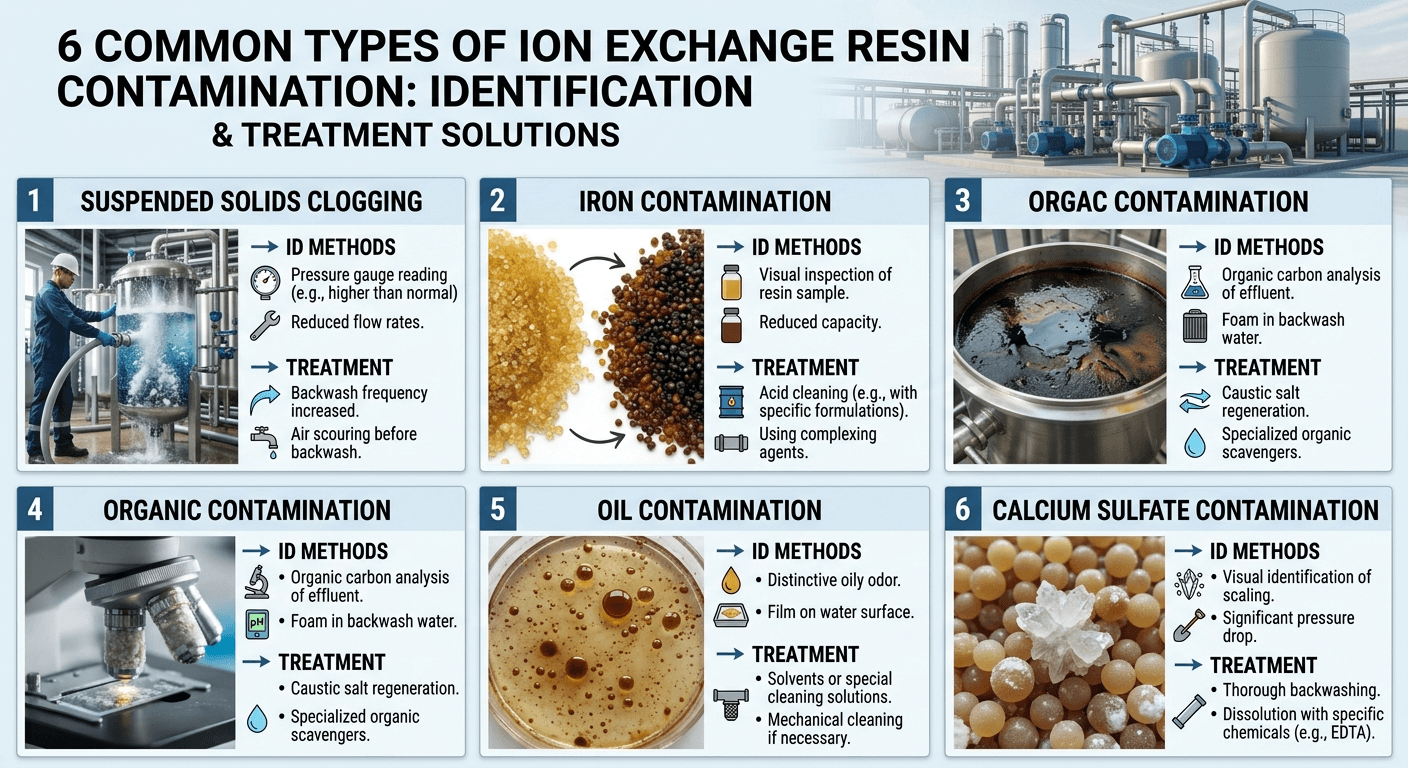
1. Suspended Solids Clogging
Suspended solids clogging is a common problem in all resin systems and is the most easily overlooked form of mild contamination.
When raw water pretreatment is inadequate, filter units fail, or influent turbidity remains consistently high, sediment and fine particles in the water will gradually accumulate in the gaps of the resin bed. These particles will block the water flow channels between resin particles and also coat the resin surface, preventing the resin from fully contacting the influent.
Typical operational manifestations include a rapid increase in resin bed pressure drop, increased water flow resistance, and higher pump output at the same flow rate. If left untreated, the resin's working exchange capacity will gradually decrease, and the cycle water production will subtly diminish.
The key to dealing with this type of clogging lies in daily prevention. First, stabilize the pretreatment unit and control the influent turbidity within acceptable limits to reduce the amount of particulate matter introduced into the resin bed at the source.
For systems already experiencing clogging, the frequency and duration of backwashing can be appropriately increased to flush out loose suspended solids from the surface using water flow. For resin layers that are firmly packed and cannot be removed by ordinary backwashing, introducing compressed air to scrub the resin layer, combined with backwashing, will significantly improve the cleaning effect.
2. Iron Contamination
Both cation and anion resins can become contaminated with iron, with anion resin often suffering greater damage from iron contamination.
Iron-contaminated resin will change its appearance from normal light yellow or beige to dark brown, and in severe cases, it will turn completely black. Iron impurities not only occupy the resin's exchange sites but also accelerate the degradation and aging of anion resin, making it a type of contamination that significantly impacts resin lifespan.
Iron can originate from many sources. Iron ions naturally present in the raw water, rust from pipe corrosion, and residues from using iron salts as coagulants can all enter the cation resin with the influent. Iron in anion resin mostly comes from the regenerated solution, often accumulating in amounts many times higher than in cation resin, and is completely ineffective in ordinary regeneration processes.
The most common method for treating iron contamination is soaking in high-concentration hydrochloric acid. Generally, a 10%-15% hydrochloric acid solution is prepared, ensuring the resin is completely submerged, and the solution is soaked for 5 to 12 hours. For severe contamination, the soaking time can be extended.
If the use of hydrochloric acid is restricted on-site, complexing agents such as citric acid, aminotriacetic acid, and EDTA can be used. These can form stable complexes with iron ions, making them easier to desorb from the resin structure and causing less damage to the resin itself.
3. Organic Contamination
Organic contamination mainly occurs in styrene-based strong-base anion exchange resins and is a long-standing headache for many desalination systems.
Several typical characteristics indicate organic contamination: the resin color gradually darkens, from light yellow to dark brown or even black; the working exchange capacity continuously decreases and is difficult to recover after regeneration; the effluent pH is lower than normal, conductivity increases, and silica leakage significantly increases, requiring more cleaning water than before.
These organic substances are mostly natural organic matter such as humic acid and fulvic acid from the raw water, but some also come from organic pollutants brought in by industrial wastewater. These substances have large molecular weights and are easily adsorbed by resins. Ordinary alkali regeneration is insufficient for complete elution, and over time, this gradually clogs the resin's exchange sites.
The conventional resuscitation method is the alkaline salt method, which involves cleaning with a mixture of 10% sodium chloride and 4%-6% sodium hydroxide. The total volume of the solution is generally three times the resin bed volume, flowing slowly and evenly through the resin bed.
After introducing the second bed volume of solution, the water supply is stopped, allowing the resin to soak for 8 hours or overnight, before introducing the remaining mixture. It is best to preheat the solution to 40°C, as higher temperatures improve the desorption efficiency of organic matter.
Adding approximately 1% sodium phosphate or sodium nitrate to the mixture, while simultaneously agitating the resin bed with compressed air, can further enhance the cleaning effect.
If the alkaline salt method is still ineffective, sodium hypochlorite cleaning can be considered. Before operation, at least one bed volume of 10% sodium chloride solution should be flowed through the resin bed to completely deactivate it.
The sodium hypochlorite solution is prepared with an available chlorine content of 1%, and the total volume used is the same as three resin bed volumes. After the second volume of solution is used up, soak for 4 hours without heating. Finally, the residual sodium hypochlorite must be thoroughly rinsed off, and the waste liquid discharged into the sewer must be properly disposed of to avoid safety risks.
4. Silica Contamination
Silica contamination primarily occurs in strong-base anion exchange resins, especially in equipment and systems using a combination of strong and weak anion exchange resins.
The formation of silica contamination is directly related to the regeneration process. During resin regeneration, silicates displaced from the resin precipitate out in a colloidal state and adhere to the resin surface due to the decreased pH of the regeneration solution. Over time, the silica removal efficiency of the anion exchanger will significantly decrease, and the overall exchange capacity of the resin will be affected, ultimately leading to an increase in the silica content of the effluent.
This type of contamination is mostly caused by insufficient regeneration, but some cases are due to the resin not being regenerated in time after failure, allowing silicic acid to gradually polymerize and deposit.
To treat silica contamination, soaking in a dilute, warm alkaline solution is sufficient. For routine contamination, a 2% sodium hydroxide solution is used, with the temperature controlled at around 40℃. After soaking, rinse thoroughly.
For more severe contamination, the sodium hydroxide concentration can be increased to 4%, and the solution heated to 40℃ can be used for circulating cleaning to fully dissolve the colloidal silica in the alkaline solution before flushing it out of the system.
5. Oil Contamination
Oil contamination typically occurs in systems with oil leaks from equipment or raw water containing mineral oil, and is a sudden type of contamination.
When mineral oil comes into contact with resin, it either adsorbs onto the resin skeleton or coats the surface of resin particles, directly clogging the resin's micropores. The consequence is a rapid decrease in resin exchange capacity, a significant reduction in cycle water production, and in severe cases, the growth of microorganisms, leading to secondary contamination.
Upon discovering oil contamination, the first step is to locate the leak point and eliminate the source of the problem to prevent further oil contamination into the system.
To clean oil-contaminated resin, a circulating 8%-10% sodium hydroxide solution at approximately 60°C can be used, maintaining a stable solution concentration throughout the process. Alternatively, solvents such as petroleum ether, No. 200 solvent gasoline, or surfactants such as polyoxyethylene octylphenol can be used for cleaning, offering more targeted treatment for oil contamination.
6. Calcium Sulfate Contamination
Calcium sulfate contamination only occurs in calcium-type cation exchange resin systems regenerated using sulfuric acid, and is a scaling-type contamination caused by improper operation.
Improper regeneration operations can cause calcium sulfate precipitates to form in the resin layer. This not only makes post-regeneration cleaning difficult, but the wash solution also retains hardness for a long time. During operation, precipitates will slowly dissolve into the effluent, leading to increased hardness and a continuous decrease in the cation exchange capacity.
To prevent calcium sulfate precipitation, the concentration of sulfuric acid in the regenerated solution can be appropriately reduced, and the flow rate of the regenerated solution can be increased. A stepwise regeneration method can also be used, gradually increasing the concentration of the regenerated solution and gradually decreasing the flow rate to reduce the probability of calcium sulfate precipitation.
If precipitation has already occurred in the resin bed, first backwash repeatedly with large amounts of soft water to flush out the loose deposits. Then, use 10% hydrochloric acid at a volume of 3 bed volumes at a flow rate of 2.0 BV/h to repeatedly wash and dissolve the calcium sulfate.
It is important to note that hydrochloric acid dissolves calcium sulfate very slowly; this process should not be rushed and requires multiple backwashes for gradual removal. Furthermore, the dissolution process is exothermic, so temperature changes must be monitored during operation. If the budget allows, EDTA sodium salt can be used for treatment, which is more effective but significantly more expensive.
7. General Procedure for Resin Cleaning and Recovery
When encountering resin contamination, do not blindly add chemicals immediately. First, determine the type of contamination based on the effluent indicators and resin appearance, then treat according to the steps. In most cases, this can restore 70-80% or more of the performance.
First, perform backwashing. Use incoming water to backwash the resin layer from bottom to top, allowing the resin to fully expand and loosen, washing away suspended solids and broken resin on the surface. After backwashing until the effluent is clear and free of obvious impurities, then introduce chemical cleaning agents.
Next is chemical cleaning. For metallic and scaling contaminants, use acidic agents; for organic and silica contaminants, use alkaline or alkaline salt solutions. The agent concentration, temperature, and contact time must be adjusted according to the degree of contamination. Higher concentrations are not always better; excessively high concentrations may damage the resin structure.
After cleaning, perform thorough forward and backwashing to completely remove any residual agents and dissolved impurities. Do not allow cleaning agents to remain in the resin, as this will affect the quality of the effluent in subsequent operations.
After rinsing to the required standards, perform a complete regeneration process according to the normal procedure to restore the resin's exchange capacity. After regeneration, test the conductivity, hardness, and silica content of the effluent and compare these values with those before cleaning to assess the actual effectiveness of the regeneration.
8. How to Prevent Resin Contamination in Daily Operations
Compared to cleaning and regeneration only after contamination, daily preventative maintenance is actually more worry-free and cost-effective.
Pretreatment is the first line of defense. Filtration and activated carbon adsorption units must be properly maintained to remove suspended solids and organic matter from the raw water before it enters the resin bed. For water with high organic matter content, using anti-contamination types such as macroporous weak-base anion exchange resins or acrylic resins can significantly reduce the probability of contamination.
Proper regeneration procedures are also crucial. Follow the prescribed procedures for regeneration solution concentration, flow rate, and dosage. Don't cut corners; incomplete regeneration is a major cause of contamination. Regenerate the resin as soon as it reaches a certain level of inertia; don't wait until it's deeply degraded, at which point impurities like silica and organic matter are more likely to adhere to the resin.
Routine operation doesn't require overly complex monitoring; simply monitoring a few standard parameters is sufficient. Regularly record and compare the pressure drop of the resin bed, the conductivity and hardness of the effluent, and the resin's appearance color. Early detection and troubleshooting are crucial. Minor contamination is easy to handle, but prolonged contamination not only makes cleaning more difficult but can also cause irreversible damage to the resin.
In general, ion exchange resin contamination is a common problem in water treatment systems. Don't immediately replace the resin every time water quality declines. First, accurately determine the type of contamination, select the appropriate cleaning agents and processes, and then combine this with routine preventative maintenance. This will usually restore the resin to a good working condition, stabilizing effluent quality, extending the resin's lifespan, and reducing overall operating costs.
.png)
