Ion exchange resins are essential consumables in fields such as industrial pure water production, water softening, ion removal from wastewater, and condensate polishing; the vast majority of industrial water treatment systems rely on the combined use of cation and anion exchange resins.
However, during equipment selection, operation and maintenance, and resin replacement, many overseas water treatment engineers, procurement personnel, and plant operators frequently confuse the application scenarios, regeneration methods, and suitable water quality conditions for these two types of resins. This confusion leads to a series of issues, including substandard effluent quality, skyrocketing regeneration costs, and significantly shortened resin service life.
Basic Definition of Anion and Cation Exchange Resins: Core Positioning of the Two Types of Resins
General Overview of Ion Exchange Resins
Ion-exchange resins are a class of synthetic functional polymers featuring a three-dimensional, cross-linked network structure. Embedded within the resin beads are active functional groups capable of ion exchange; these groups facilitate reversible ion-exchange reactions with free ions in aqueous solutions, thereby precisely removing excess anionic and cationic impurity ions to achieve water purification and desalination. They currently represent the most mature and cost-effective consumable materials for desalination in industrial water treatment.
Basic Concepts of Cation Exchange Resins
Cation exchange resins possess fixed negative charges throughout their structure, with acidic functional groups attached to the resin backbone; they are primarily used to adsorb positively charged cationic impurities from water. During operation, the resin releases hydrogen ions in exchange for metal cations—such as calcium, magnesium, sodium, and potassium—present in the water, and is commonly employed in water softening and pretreatment processes for cation removal.
Basic Concepts of Anion Exchange Resins
Anion exchange resins carry fixed positive charges and feature basic functional groups attached to the resin backbone; they primarily target and adsorb negatively charged anionic impurities from water. During operation, they release hydroxide ions to displace harmful anions—such as chloride, sulfate, and nitrate—present in the water. Typically, they are positioned downstream of cation exchange resins to complete the overall water demineralization process.
Differences in Chemical Structure: The Fundamental Reason Determining Resin Adsorption Capacity
Structural Characteristics of Functional Groups in Cationic Resins
Cation exchange resins utilize acidic functional groups as their primary active exchange sites. Mainstream products on the market fall into two categories: strong-acid and weak-acid cation resins. Strong-acid resins typically feature sulfonic acid groups; they operate stably across a wide pH range, functioning effectively in both acidic and alkaline environments. Weak-acid resins primarily feature carboxylic acid groups; they are suitable only for neutral to weakly alkaline aqueous environments but offer superior adsorption performance for large-molecule cations.
The overall polymer backbone is dense, with active exchange sites evenly distributed across the surface and within the micropores of the resin beads, ensuring a continuous and stable cation exchange process.
Structural Characteristics of Functional Groups in Anionic Resins
Anion exchange resins feature basic amine functional groups and are categorized into strong-base and weak-base types. Strong-base resins contain quaternary ammonium groups capable of removing all inorganic anions and most organic anions from water, making them a standard material for producing purified water; weak-base resins contain tertiary amine groups that can only adsorb anions derived from strong acids, leaving weak-acid anions—such as silicates—unremoved.
Fundamental Differences Stemming from Structural Variations
The functional groups inherent to the resin directly determine the nature of the fixed charge on its surface: acidic functional groups render cation-exchange resins negatively charged, allowing them to bind only with positively charged ions, whereas basic functional groups render anion-exchange resins positively charged, allowing them to bind only with negatively charged ions. This fundamental chemical principle explains why the two types of resins cannot substitute for one another and must be used in conjunction.
Physical Property Differences: Appearance, Density & Strength
Differences in Appearance and Color
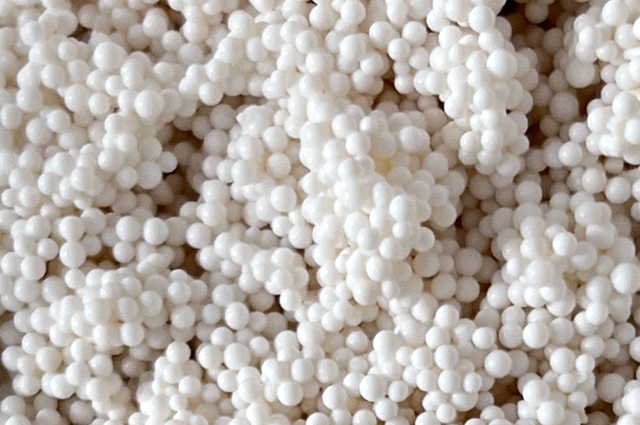
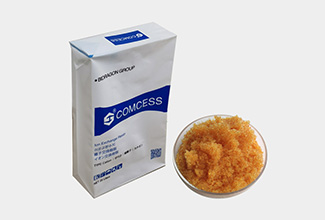
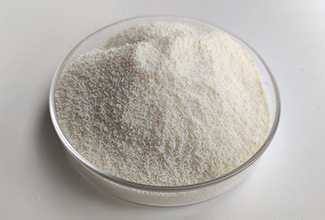
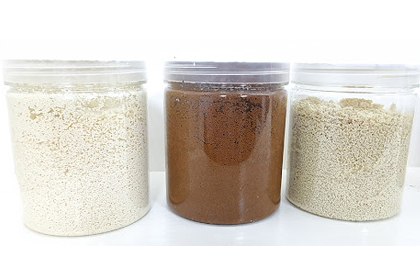
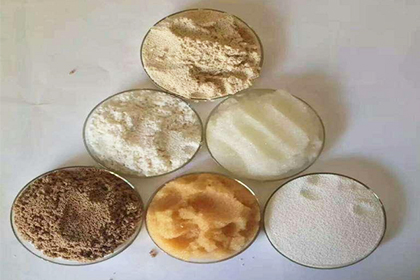
Conventional gel-type industrial ion exchange resins are spherical particles, yet they exhibit distinct color differences: standard strong-acid cation resins typically appear as translucent yellow-brown or dark brown spheres, whereas strong-base anion resins appear as opaque milky-white or pale yellow spheres. Preliminary differentiation can be made quickly by the naked eye without the need for specialized testing equipment.
Differences in Bulk Density and Wet Density
Given the same particle size, cation resins generally possess higher overall density than anion resins, exhibiting greater wet true density and bulk density. During the stratified operation and maintenance of mixed-bed resins, the difference in density allows for automatic separation of the anion and cation resins via backwash water flow; this density difference serves as the fundamental physical basis for separating the two resin types in mixed-bed equipment.
Mechanical Strength and Osmotic Shock Resistance
Cation resins generally have a higher degree of cross-linking, offering superior resistance to osmotic shock and breakage caused by water pressure compared to anion resins. Anion resins feature a looser microporous structure; consequently, they exhibit a slightly higher breakage rate following repeated cycles of swelling and contraction during regeneration, resulting in a typically shorter replacement cycle compared to cation resins.
Differences in Stability in Acidic and Alkaline Environments
Cation resins exhibit exceptional acid resistance and can operate for extended periods in highly acidic environments. Anion resins possess excellent alkali resistance but are vulnerable to strong acid shock. As the two resin types exhibit diametrically opposed resistance characteristics regarding extreme pH environments, the mixing of acidic and alkaline cleaning agents during operation and maintenance is strictly prohibited.
Ion Exchange Mechanism: Core Operating Logic Differences
Cation Exchange Resin Reaction Process
As raw water enters the resin bed, positively charged cations—such as calcium, magnesium, and sodium ions—are immobilized on the resin framework through electrostatic adsorption; simultaneously, the resin releases hydrogen ions into the water. Following cation resin treatment, metal cations are completely removed, rendering the water weakly acidic and preparing the feed water for the subsequent anion resin treatment stage.
Anion Exchange Resin Reaction Process
The acidified water flows into the anion resin bed, where anions such as chloride, sulfate, nitrate, and silicate are adsorbed and immobilized by the resin, which simultaneously releases hydroxide ions. These hydroxide ions combine with the hydrogen ions present in the water to form pure water molecules, ultimately achieving complete demineralization.
Differences in Reaction Conditions and Equilibrium
The cation exchange reaction proceeds more rapidly and is minimally affected by fluctuations in influent pH. In contrast, anion exchange resins are more sensitive to influent water quality and temperature; anion exchange efficiency drops significantly in low-temperature environments. Furthermore, the two types of resins possess different ion exchange equilibrium constants; given identical influent water quality, the saturated adsorption capacity of cation resins is generally higher than that of anion resins.
Regeneration Differences: How Saturated Resins Are Restored Differently
Cation Resin Regeneration Process and Reagents
Once cation resins become saturated with adsorbed metal cations, they lose their water purification capacity and require an acidic regenerant for restoration. Hydrochloric acid or dilute sulfuric acid are the standard industrial regenerants; the high concentration of hydrogen ions displaces metal cations (such as calcium and magnesium) adsorbed on the resin surface, thereby restoring the resin's initial exchange capacity. The resulting regeneration waste is primarily acidic, saline wastewater.
Anion Resin Regeneration Process and Reagents
Saturated anion resins require an alkaline regenerant, with sodium hydroxide solution being the most common choice. High concentrations of hydroxide ions displace the various anions adsorbed on the resin surface, restoring the resin's adsorption activity; the resulting regeneration waste is primarily alkaline, saline wastewater.
Differences in Regeneration Duration and Reagent Dosage
For a given vessel volume and influent load, anion resin regeneration requires a larger quantity of reagents and a longer rinsing duration compared to cation resin, resulting in higher overall regeneration operating costs. This is the primary reason why the maintenance and operating costs for anion resins consistently exceed those for cation resins in pure water systems.
Cation vs. Anion Exchange Resins: Core Parameter Comparison
|
Comparison Dimension |
Cation Exchange Resin |
Anion Exchange Resin |
|
Fixed surface charge on resin |
Negative charge |
Positive charge |
|
Core functional group |
Sulfonic acid groups, carboxylic acid groups (acidic groups) |
Quaternary ammonium groups, tertiary amine groups (basic groups) |
|
Type of ions removed |
Various metal cations in water |
Various inorganic and organic anions in water |
|
Standard regeneration agents |
Hydrochloric acid, dilute sulfuric acid (acidic reagents) |
Sodium hydroxide (alkaline reagent) |
|
Applicable operating pH range |
Stable operation across the full pH range (1–14) |
pH 4–12; susceptible to damage in extremely strong acidic environments |
|
Appearance/Color |
Transparent spherical beads (yellowish-brown to dark brown) |
Opaque, spherical beads (milky white or pale yellow) |
|
Water treatment sequence |
Pre-treatment |
Post-treatment |
Summary of Key Points: The fundamental differences between the two types of resins lie in three areas—charge characteristics, regeneration agents, and the types of ions removed—with all variations in physical properties and operational performance stemming from the resins' inherent charge characteristics.
Industrial Application Scenarios: Logic of Individual and Combined Use
Application Scenarios Specific to Cation Exchange Resins
Operating conditions allowing for standalone use (without an accompanying anion resin): softening of industrial boiler feedwater by removing calcium and magnesium ions to prevent pipeline scaling; removal of heavy metal cations from industrial wastewater; pre-polishing of power plant condensate; and basic hardness removal from groundwater and tap water.
Application Scenarios Specific to Anion Exchange Resins
Primarily used for the targeted removal of harmful anions from water: treating drinking water and industrial wastewater with excessive nitrate levels; removing corrosive chloride ions; decolorizing chemical wastewater containing organic anions; and polishing to remove residual weak acid anions in high-purity water systems.
Operational Logic of Combined Cation and Anion Resin Desalination
The production of industrial high-purity water and ultrapure water requires either a series process (cation resin followed by anion resin) or a mixed-bed process: in the series process, raw water passes through the cation resin to remove cations and then through the anion resin to remove anions; in mixed-bed equipment, the two resins are uniformly mixed to simultaneously exchange both cations and anions, yielding effluent purity far superior to that of single-stage series systems—making it the mainstream process for ultrapure water production in the high-end electronics and pharmaceutical industries.
Water Treatment Resin Selection: A Practical Guide to Accurate Choice
Selection based on influent impurity types
If the only issues are scale formation and excessive metal ions, a strong acid cation (SAC) resin suffices; if the water has high salinity, excessive anions, or high conductivity, an anion resin must be included; if the raw water has high total dissolved solids (TDS), a combination of cation and anion resins is required.
Selection based on effluent quality standards
For standard boiler feedwater softening, a strong acid cation resin alone meets requirements; for industrial-grade pure water, a cation bed followed by an anion bed in series is used; for electronic- or pharmaceutical-grade ultrapure water, a mixed-bed system containing both cation and anion resins is necessary.
Selection based on on-site regeneration capabilities
If the site has only an acid regeneration system, an anion resin cannot be used in isolation; if only alkali dosing equipment is available, a cation resin cannot be used. Compatibility with on-site acid/alkali dosing systems must be verified during the selection phase to ensure resin regeneration can be performed later.
Selection based on process configuration
In separate-bed systems, the cation resin is placed upstream and the anion resin downstream; in integrated mixed-bed systems, cation and anion resins are loaded in a standard ratio, utilizing density differences during backwashing to achieve separation and ensure effective regeneration.
Conclusion
Overall, there is no inherent superiority or inferiority between cationic and anionic resins; they simply serve different functional roles. Cationic resins capture positively charged metal ions from the water and are regenerated using acid, whereas anionic resins capture negatively charged acid radical ions and are regenerated using alkali.
These two types of resins complement each other and cannot substitute for one another. While cationic resins alone may suffice for simple water softening applications, processes requiring comprehensive demineralization or the production of high-purity water rely on the synergistic operation of both resin types.
In practical equipment operation, maintenance, and procurement, focusing on three key factors—charge characteristics, the type of ions adsorbed, and the regeneration chemicals—allows for a clear distinction between the two resin types. This approach helps effectively avoid common operational errors such as incorrect resin selection, the mixing of regeneration chemicals, or improper loading sequences, thereby enhancing the operational stability of the water treatment system and reducing long-term consumable costs.