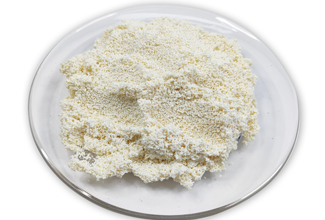
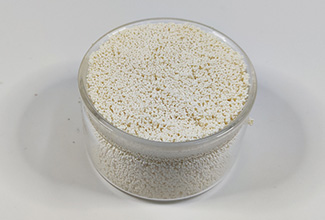
Starch sugars—a category of essential food ingredients derived from starch through liquefaction and saccharification—encompass products such as glucose syrup, maltose syrup, and high-fructose corn syrup (HFCS). These are widely used across industries including beverages, confectionery, baked goods, and seasonings. Crude syrup obtained after saccharification contains a significant amount of impurities, such as inorganic ash, colorants, organic acids, amino acids, and trace proteins. Relying solely on filtration and decolorization with activated carbon is often insufficient to meet the stringent requirements for purity, color, and thermal stability demanded by high-end products.
Ion exchange resins are the core materials used in the refining of starch sugars, playing an indispensable role in processes such as deashing, decolorization, final purification, and the separation of sugar components. This article provides a systematic overview of the operating principles, process stages, resin selection criteria, and process control logic for ion-exchange resins throughout the entire starch sugar refining workflow, helping readers understand how these resins are implemented in starch sugar production lines.
What is Starch Sugar Refining, And What Impurities Need to be Removed?
The upstream processes for producing starch-based sugars primarily include starch liquefaction, saccharification, and coarse filtration. The crude syrup obtained from these steps still falls significantly short of the standards required for the finished product. The core objective of the refining process is to selectively remove various harmful impurities from the syrup, thereby ensuring consistent product quality.
Types of Major Impurities in Starch Syrup
Impurities in crude syrup can be categorized into several groups: inorganic cations and anions (such as calcium, magnesium, sodium, sulfate, and chloride ions), colored substances generated via the Maillard reaction, organic acids, amino acids, peptides, and colloidal proteins. Although present in relatively low concentrations, these impurities directly affect the quality of the final syrup product.
Limitations of Filtration and Activated Carbon Processes
Coarse filtration can only remove suspended solids; while activated carbon is effective at adsorbing pigments, it cannot efficiently remove ionic ash. Residual ash can lead to color reversion and scaling during the evaporation and concentration stages. Furthermore, it interferes with the activity of downstream isomerases, thereby limiting improvements in the quality of high-fructose corn syrup. This is the fundamental reason why an ion-exchange process is an essential component of any starch-based sugar production line.
Working Principle of Ion Exchange Resins for the Purification of Starch Syrup
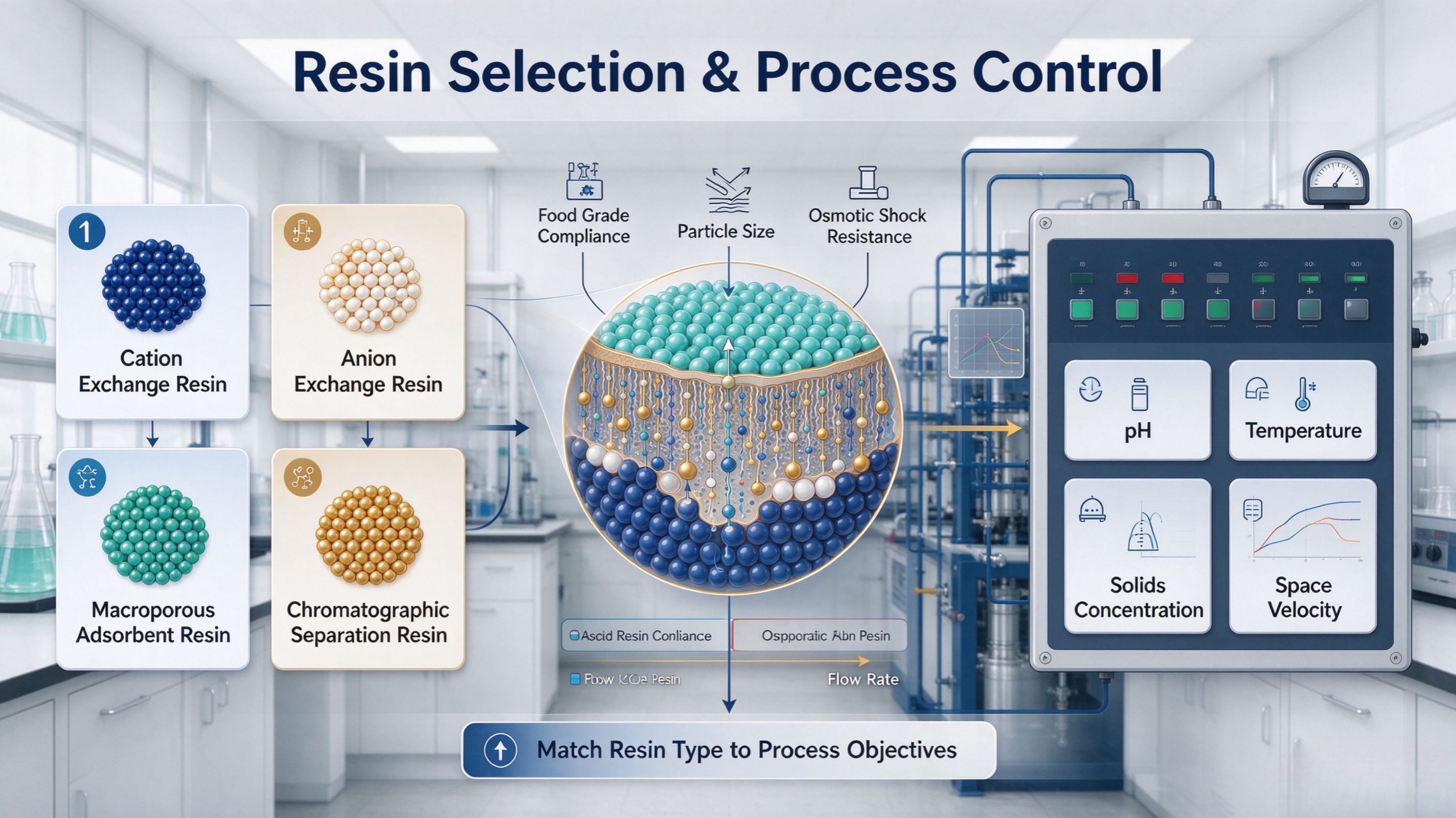
To make effective use of resins, one must first distinguish the operating mechanisms of the different types. The resins used in the refining of starch-based sugars are primarily categorized into three types: cation-exchange resins, anion-exchange resins, and macroporous adsorption resins.
Mechanism of Cation Exchange Resins
Strong-acid cation exchange resins release hydrogen ions while capturing metal cations—such as calcium, magnesium, and sodium—from the syrup. These metal ions are exchanged onto the resin framework, while the released hydrogen ions enter the syrup system, neutralizing any alkaline ions present.
Mechanism of Anion Exchange Resins
Strong-base or weak-base anion exchange resins release hydroxide ions, adsorbing anions such as sulfates, chlorides, and organic acid radicals from the syrup. Certain strong-base anion exchange resins also possess the capacity to adsorb colored organic compounds, thereby assisting in the decolorization process.
Selective Adsorption Characteristics of Macroporous Adsorption Resins
Macroporous adsorption resins function not through ion exchange, but via physical adsorption. They capture large-molecule colored substances and polyphenolic impurities, while exhibiting very low affinity for sugar molecules; this allows for the removal of pigments without any loss of sugar content.
Impact of Key Operating Conditions on Resin Performance
The temperature, solids concentration, and pH value of the incoming syrup all influence the ion-exchange capacity and adsorption efficiency of the resins. In starch-sugar processing, the temperature is typically maintained at an optimal level to enhance the rate of ion migration, while simultaneously preventing the degradation and discoloration of sugars that could be caused by excessive heat.
Demineralization and deashing: The core process in the refining of starch-based sugars
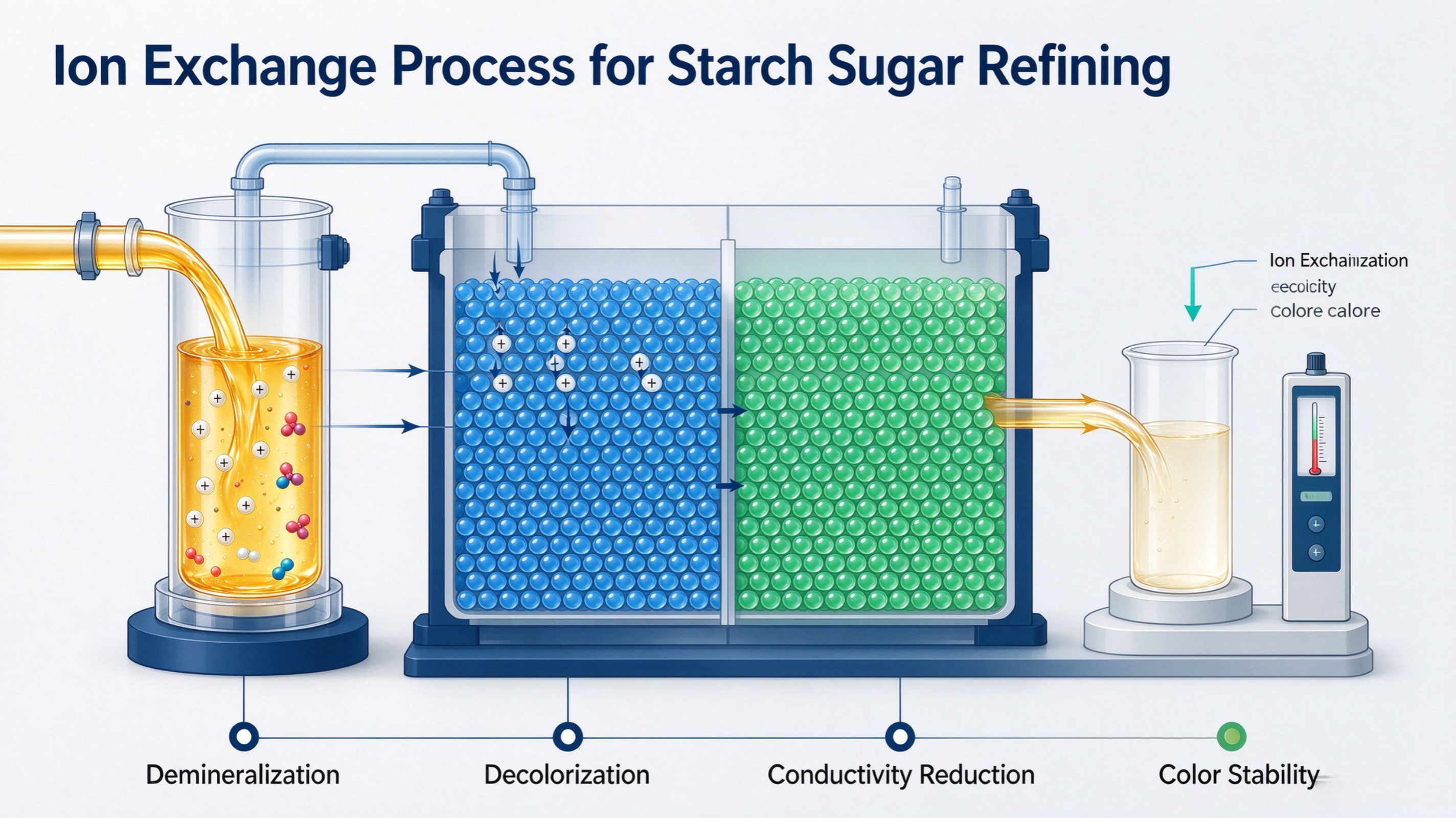
Demineralization is the primary function of ion-exchange resins in starch-sugar production and a key focus within the entire refining process. The industry standard for initial desalination involves a two-stage system consisting of a cation-exchange bed followed by an anion-exchange bed.
Process Sequence: Cation-Exchange Bed Followed by Anion-Exchange Bed
The process sequence is fixed as a strong-acid cation-exchange resin bed followed by a weak-base anion-exchange resin bed. The cation-exchange bed removes metal ions and releases H⁺ ions, which lowers the pH of the feed stream. This reduces the load on the anion-exchange resin and prevents calcium and magnesium ions from precipitating within the anion-exchange bed, which would otherwise contaminate the resin.
Key Ionic Components to Be Removed
The target ions for removal include cations such as Ca²⁺, Mg²⁺, and Na⁺, as well as anions such as sulfate, chloride, and organic acid anions (e.g., lactate). Collectively, these ions are referred to as "ash content," which is typically monitored online via electrical conductivity.
Negative Impacts of Incomplete Ash Removal
Residual ash can lead to several issues: it facilitates color reversion (discoloration) during the heating stages of concentration, causes scaling on the inner walls of evaporator tubes, and reduces the stability of isomerase enzymes. In the production of high-fructose corn syrup, this directly impairs the glucose-to-fructose isomerization conversion rate and shortens the operational lifespan of the enzymes.
Decolorization of Syrup Using Ion Exchange Resins
Activated carbon decolorization is a traditional method, while resin-based decolorization serves as a complementary, advanced-level solution; the two have distinct roles and are often used in combination.
Sources of Color in Starch Syrups
The color in syrups primarily originates from Maillard reaction products, melanoidins, and complexes formed between polyphenols and proteins. These high-molecular-weight colored substances are difficult to remove once activated carbon adsorbents have reached their saturation point.
Differences in Decolorization: Anionic Resins vs. Macroporous Resins
Strongly basic anionic resins rely on electrostatic interactions to adsorb negatively charged colored organic compounds, whereas macroporous adsorption resins utilize their pore size and specific surface area to physically adsorb high-molecular-weight pigments. Macroporous resins are less susceptible to interference from small-molecule ions, making them well-suited for applications with high pigment loads.
The Value of Resin Decolorization for Finished Product Stability
Syrups subjected to intensive resin-based decolorization exhibit a significantly slower rate of color reversion during long-term storage or high-temperature sterilization. This ensures a stable color in the final product, meeting the requirements for high-end food formulations.
Mixed-bed polishing: The final refining stage for syrup
After passing through the two-bed ion-exchange system, the conductivity and color value of the syrup are significantly reduced; however, trace residual ions and low concentrations of pigments may still persist. The mixed-bed unit is employed for final, high-precision purification.
Structure and Positioning of the Mixed-Bed Ion Exchanger
A mixed-bed ion exchanger contains a uniform mixture of both cation and anion exchange resins. It is positioned downstream of the two-stage (cation-anion) demineralization process, serving as a final refining unit to produce ultra-high-purity syrup.
Objectives of the Mixed-Bed Process
The process is designed to capture trace cations and anions—as well as minute quantities of colored organic matter—that remain after the two-stage demineralization process. This further reduces the electrical conductivity of the final product, ensuring it meets the stringent specifications required for high-grade glucose and maltose syrups.
Limitations of the Mixed-Bed Process
The regeneration of mixed-bed resins is more complex, requires a higher consumption of acid and alkali regenerants, and results in shorter operational cycles. Consequently, such units are typically included only in production lines for high-grade products; they are not a mandatory requirement for all starch-based sweetener production lines.
Ion Exchange Resins for The Chromatographic Separation of High Fructose Corn Syrup
The primary difference between high-fructose corn syrup (HFCS) and regular glucose syrup is the need to separate glucose from fructose; this process is achieved through chromatographic separation using calcium-form cation-exchange resins.
Separation Principle of Calcium Form Resins
Calcium-form cation-exchange resins exhibit different affinities for glucose and fructose. Fructose binds more strongly to the resin and, consequently, moves more slowly through the chromatographic column. This difference in retention time allows for the separation of the two sugar components.
Production of Various High-Fructose Corn Syrup (HFCS) Grades
Using a chromatographic separation system, fructose-enriched and glucose-enriched streams can be collected separately. These streams can then be blended to produce high-fructose corn syrups with varying fructose content, such as F42, F55, and F90.
Distinguishing Between Purification Resins and Chromatographic Separation Resins
It is important to note that the ion-exchange resins used for demineralization and decolorization are distinct from the calcium-form resins specifically designed for chromatographic separation. They differ in terms of resin backbone, particle size, degree of cross-linking, and conversion method; therefore, they cannot be used interchangeably.
Resin Regeneration and Cyclic Operation Process
Once ion-exchange resins become saturated with adsorbed impurities, their exchange capacity declines, necessitating regeneration to restore their performance; the cyclic regeneration of these resins is fundamental to the stable operation of the starch-sugar production process.
Criteria for Determining Resin Exhaustion
In production, online monitoring of conductivity and color is used. When the output parameters exceed established thresholds, it indicates that the resin has reached its "breakthrough point," necessitating a switch to an alternative bed and the initiation of a regeneration cycle.
Regeneration Agents for Various Resins
Strong-acid cation-exchange resins are regenerated using hydrochloric acid, while anion-exchange resins are regenerated using sodium hydroxide. Certain calcium-form resins, used for chromatographic separation, are regenerated via conversion using a brine solution. Macroporous adsorption resins are typically cleaned by flushing with hot water or a low-concentration solvent.
Purpose of the Regeneration Displacement and Rinsing Steps
Following regeneration, thorough rinsing is essential to completely remove residual regeneration agents and displaced impurities. This prevents the carryover of acids or bases into the syrup, which could otherwise cause pH fluctuations or product contamination.
Impact of Flow Rate and Feed Load on Operational Cycles
If the feed flow rate is too high, impurities may not have sufficient time for ion exchange, leading to premature breakthrough. Similarly, an excessively high solids content increases the load on the resin, thereby shortening the operational cycle. Consequently, production must be maintained within the designed flow rate specifications.
Criteria for Resin Selection in Starch Sugar Refining Processes
Food-grade applications have strict requirements; therefore, selection cannot be based solely on exchange capacity—it must be determined by evaluating a comprehensive set of criteria.
Compliance Requirements for Food Contact Materials
All resins that come into direct contact with syrup must comply with relevant food-contact standards, meet specified limits for extractable substances, and ensure the safety of the final food product.
Selection of Resin Backbone Structure
Resins are categorized into styrene-based and acrylic-based types. Gel-type resins are suitable for standard ion removal, while macroporous resins offer superior resistance to fouling, making them ideal for operating conditions with high loads of impurities and pigments.
Physical Strength Specifications for Resins
In starch-sugar production lines, resins undergo repeated regeneration, expansion, and contraction. Consequently, they must possess excellent resistance to osmotic shock and high structural integrity of the beads. This minimizes bead breakage, reduces resin loss, and prevents resin fragments from migrating into downstream processes.
Matching Resin Types to Process Objectives
Resin selection is based on the specific function of each process stage: standard strong-acid/weak-base resins are used for demineralization; macroporous adsorbent resins are employed for deep decolorization; mixed-bed resin systems are utilized for final polishing; and specialized calcium-form chromatographic resins are used for the separation of glucose and fructose.
Process Control Parameters Affecting The Performance of Ion Exchange Operations
Even with high-performance resins, improper control of process parameters can lead to issues such as poor ash removal, inconsistent decolorization, and rapid resin contamination or deactivation.
Space Velocity and Feed Flow Rate Control
Space velocity is a core parameter, representing the volume of syrup processed per unit volume of resin per unit of time. An excessively high space velocity leads to substandard treatment, while an excessively low one reduces production capacity and increases production costs.
Feed pH, Temperature, and Solids Concentration
These three parameters are interrelated and must be maintained within the ranges recommended for the resin. Low temperatures result in slow ion-exchange rates; deviations in pH can affect the ionization of the resin’s functional groups; and high solids concentrations increase syrup viscosity, thereby raising the resistance to ion diffusion.
Impurity Contamination Risks and Upstream Protection
Proteins and colloidal substances are primary contaminants for resins; they can coat the resin surface and clog its pores, causing irreversible contamination. Consequently, filtration and activated carbon pretreatment are typically implemented upstream of the ion-exchange process to serve as a protective barrier.
Placement of Online Monitoring Points
Monitoring points for conductivity and color should be established at the outlets of the cation exchange column, anion exchange column, and mixed-bed column. These allow for real-time assessment of operational status, early detection of potential resin exhaustion, and the assurance of consistent product quality.
Conclusion
Throughout the entire refining process for starch-based sugars, ion-exchange resins perform four core functions: deashing, decolorization, final polishing, and the chromatographic separation of sugar components. From the removal of ionic impurities in crude syrup to the enrichment of fructose in high-fructose corn syrup (HFCS), various types of resins—working in tandem with pretreatment units such as filtration systems and activated carbon—serve to reliably control syrup conductivity, color, and thermal stability. These resins are indispensable materials for the production of high-quality starch-based sugars and HFCS. The proper selection of resin types, rigorous management of regeneration procedures, and the stabilization of process parameters are the keys to ensuring the long-term, stable operation of the entire refining section.