In the hundreds of processes involved in wafer manufacturing, ultra-pure water (UPW) is nearly ubiquitous. From post-lithography cleaning and etch residue removal to chemical mechanical polishing rinsing, each step requires water that is virtually free of impurities. Even trace metals at parts per trillion (ppt) levels or organics at sub-parts per billion (ppb) concentrations can create defects within nanoscale gates and trenches, directly reducing overall production yield. Numerous industry cases exist where batch wafer failures resulted from fluctuations in water quality—making purity selection of upstream consumables anything but trivial.
Mixed bed resins are the core consumable for final polishing stages in UPW systems, yet not all mixed bed resins meet the stringent purity requirements of semiconductor fabrication. The differences between industrial-grade, electronic-grade, and semiconductor-grade resins extend far beyond mere price variations; they reflect increasingly rigorous demands on manufacturing processes, cleaning procedures, and impurity control. This article breaks down resin types, grade classifications, and key specifications across three dimensions, helping process engineers, system integrators, and procurement professionals clarify essential selection criteria and avoid common pitfalls.
What Is Mixed-Bed Resin?
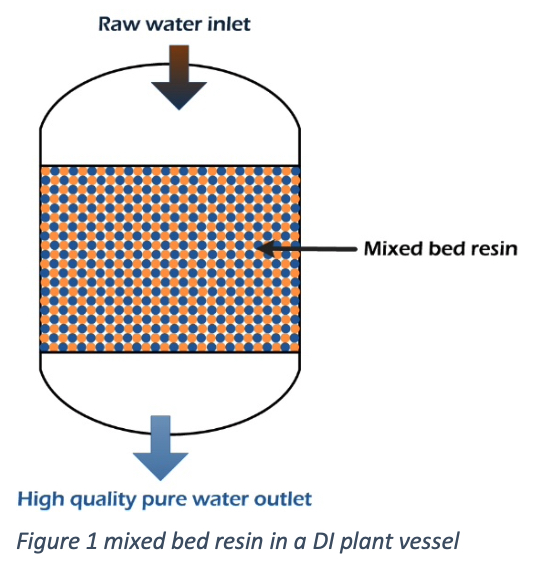
The core concept of mixed-bed resin involves mixing strong-acid cation exchange resin and strong-base anion exchange resin in a specific ratio and loading them into a single exchange column. As water flows through the resin bed, the functional groups on the resins simultaneously exchange the cations and anions present in the water, achieving deep demineralization in a single step.
Compared to "two-bed" systems where cation and anion resins are housed in separate towers, the resins in a mixed bed are in intimate, uniform contact. This setup functions like countless pairs of tiny "mixed-bed units" connected in series, resulting in more thorough exchange reactions and significantly higher effluent purity.
Due to this characteristic, mixed-bed units are rarely placed at the beginning of an ultrapure water system. Typically, after reverse osmosis (RO) and electrodeionization (EDI) have performed the bulk of the demineralization, the mixed bed handles the final "polishing" stage, elevating water quality to a level approaching that of theoretically pure water. For readers with a basic understanding of water treatment, we will skip further elaboration on these fundamental principles and move directly to the core topic of resin selection.
.png)
Three Mainstream Types Of Mixed-Bed Resins For Distinct Applications
Based on mixing methods and regeneration characteristics, the mixed-bed resins commonly used in semiconductor ultrapure water systems fall into three categories, each with vastly different operational requirements and cost structures.
On-site mixed conventional mixed bed resins represent a more traditional type of mixed bed resin. Cation exchange resins and anion exchange resins are supplied separately and are mixed and loaded on-site according to a specific ratio through manual or mechanical processes. These resins can be reused through backwashing separation, acid and alkali regeneration, and re-mixing procedures.
They were widely used in large-scale industrial ultra-pure water systems in the past and are suitable for front-end primary demineralization processes and applications with relatively high influent salt concentrations.
However, this type of resin has significant drawbacks: the precision of the mixing ratio depends heavily on operator skill; uneven mixing can lead to flow maldistribution or channeling, causing noticeable fluctuations in effluent purity; and the regeneration process requires supporting infrastructure for acid/alkali storage and wastewater treatment, resulting in high operational complexity. Furthermore, the resin's conversion rate and purity decline with each regeneration cycle, making it difficult to consistently meet the stringent terminal polishing requirements of advanced manufacturing processes.
Premixed, ready-to-use resins serve as a compromise choice for many mid-range production lines. These resins are uniformly mixed at the factory according to stoichiometric ratios and undergo pre-regeneration and initial rinsing; they are ready for immediate loading upon delivery to the site, eliminating the need for on-site mixing. Compared to resins mixed on-site, premixed resins offer superior control over mixing uniformity, preventing ratio imbalances; they also require less rinsing time to meet quality standards, thereby reducing ultrapure water consumption during the commissioning phase. Certain premixed resins capable of stratified regeneration are also compatible with polishing units equipped for on-site regeneration, striking a balance between stability and cost.
Non-regenerable, disposable polishing resins are the preferred choice for final polishing stages in advanced wafer fabrication plants. These resins undergo exhaustive regeneration and multiple ultrapure water rinses prior to shipment; the anion and cation resins are specially matched in terms of particle size and density such that they cannot be separated by backwashing, and the entire resin bed is replaced rather than regenerated on-site once exhausted. By bypassing on-site regeneration, the risks of residual regenerants and impurity contamination during the regeneration process are eliminated, allowing for exceptionally low levels of initial impurities and leachables; they typically provide stable output of 18.2 MΩ·cm ultrapure water with TOC leaching controlled to within 1 ppb. The primary drawback is the higher initial procurement cost associated with this consumable-style replacement model; consequently, they are best suited for point-of-use (POU) applications where the feed water is already of high purity and the requirements for output water stability are extremely stringent.
|
Resin Type |
Regeneration Method |
Typical Applications |
Relative Unit Cost |
|
On-site mixed conventional mixed bed |
On-site acid/alkali regeneration |
Industrial ultrapure water pre-deminarization, mature processes |
Low |
|
Pre-mixed ready-to-use mixed bed |
Partially regenerable |
Polishing units for advanced treatment, mid-tier process polishing |
Medium |
|
Non-regerable polishing resin |
Single-use (disposable) |
Advanced process terminal polishing, POU (point-of-use) water points |
High |
Resin Grade: What Does "Semiconductor-Grade" Really Mean?
Many suppliers label their products as "electronic-grade" or "semiconductor-grade," but the manufacturing standards between these grades vary significantly, so selection should not be based solely on the name.
Conventional industrial-grade mixed-bed resins are primarily manufactured to meet basic performance criteria such as exchange capacity and mechanical strength. Standard pure water is sufficient for rinsing steps. These resins tend to retain relatively higher levels of monomers, oligomers, and metal impurities, which may leach during operation. They are suitable for applications with less stringent water quality requirements, such as boiler feedwater and general industrial pure water systems.
In contrast, semiconductor-grade (also known as electronic-grade ultra-pure water-grade) resins require much stricter production controls. During polymerization, raw material purity is tightly controlled to minimize contamination at the source. In the finished product stage, high-purity water is used for extended, multi-batch rinsing processes to remove residual small-molecule organics, metal ions, and unreacted monomers from both the resin surface and pores. According to domestic industry group standards for the semiconductor sector, process mixed-bed resins must produce water with a resistivity of no less than 17.5 MΩ·cm, a TOC leaching increase of no more than 1 μg/L, and trace metal leaching strictly limited to extremely low levels. There are even higher-grade nuclear-grade resins with even tighter impurity specifications, though they come at significantly higher costs and are generally not used in semiconductor manufacturing unless required by special radiation-related processes.
As semiconductor fabrication nodes advance, the demands on resin grade continue to rise. For mature processes above 28 nm, standard electronic-grade resins typically suffice. However, at 7 nm and 5 nm nodes, tighter control over boron, silicon, and trace metals becomes necessary, requiring higher-purity semiconductor-grade polishing resins. At 3 nm and below, organic leaching and metal release must be reduced to parts per trillion (ppt) levels, pushing cleaning and production processes to new heights. In short, the more advanced the process node, the more critical the resin's "baseline purity" becomes—performance cannot be judged solely by nominal exchange capacity.
Key Specifications for Selecting Mixed-Bed Resins
When reviewing a resin specification sheet, there is no need to be overwhelmed by the dense array of parameters; focusing on a few core indicators allows you to determine whether a specific resin suits your operating conditions.
Resistivity is the most intuitive indicator of ultrapure water purity. The theoretical limit for pure water resistivity at 25°C is 18.2 MΩ·cm, which serves as the standard benchmark for water used in semiconductor manufacturing. It is important to note that resistivity is the result of the interplay between feed water quality and resin performance. Generally, the feed water resistivity for a polishing mixed bed must exceed 17.5 MΩ·cm for the resin to consistently produce water at 18.2 MΩ·cm. If the upstream water quality is poor, even the best polishing resin cannot achieve its nominal performance values. Another critical factor is the time required to meet resistivity standards after rinsing; high-quality non-regenerable polishing resins typically approach 18 MΩ·cm after processing 2–3 bed volumes of water, whereas lower-quality resins may require dozens of bed volumes—wasting pure water and delaying production schedules.
Total Organic Carbon (TOC) leaching is a hidden indicator that is easily overlooked. As resins are high-molecular-weight polymers, trace amounts of oligomers and residual monomers can leach into the water, resulting in TOC leakage. While a TOC level of a few ppb may not significantly impact mature manufacturing processes, at advanced technology nodes, sub-ppb levels of organic matter can form residues on wafer surfaces, interfering with photoresist adhesion and affecting etching uniformity. According to domestic semiconductor industry standards, the TOC increment for process mixed-bed resins must be ≤1 μg/L; high-end polishing resins typically exhibit TOC leaching below 1 ppb, with some models stabilizing at sub-ppb levels after thorough rinsing. When evaluating this metric, one should not rely solely on nominal values; requesting actual flow-test curve data provides a more reliable reference.
Exchange capacity is directly linked to the resin's service life. The total amount of ions a unit volume of resin can exchange determines the operating cycle and replacement frequency under specific conditions. A higher exchange capacity results in a longer operating cycle and fewer replacements per year. However, it is crucial to distinguish priorities: exchange capacity and purity are two independent dimensions. High-capacity industrial-grade resins are not necessarily suitable for semiconductor applications, as their levels of leachable substances may fail to meet standards. When selecting a resin, purity requirements must be satisfied first, followed by a comparison of exchange capacities; the order of priority must not be reversed.
Particle size distribution and the uniformity coefficient influence hydraulic characteristics during operation. The uniformity of resin particle size directly affects bed pressure drop, water flow distribution, and rinsing efficiency. Uniform-particle resins typically have a uniformity coefficient of around 1.1; their consistent particle size results in a denser bed, reduces the likelihood of channeling, improves ion exchange kinetics, and accelerates the rinsing process to meet purity standards. In contrast, resins with a standard Gaussian distribution exhibit uneven particle sizes and high levels of fine particles, leading to higher operating pressure drops and a greater tendency for channeling within the bed, which diminishes actual exchange efficiency.
Extractables and leachable ions represent the critical thresholds for semiconductor-grade resins, with a particular focus on boron, silicon, and trace metals. Boron and silicon are weakly dissociating substances that are difficult for standard resins to remove thoroughly; furthermore, some anion resins themselves can leach boron. In advanced manufacturing processes, boron contamination can directly alter the doping concentration of silicon wafers, causing device parameter drift. Metal ions such as iron, copper, sodium, and calcium have an even more direct impact; even release at the parts-per-trillion (ppt) level can cause surface metal contamination during wafer cleaning, leading to leakage currents and reduced yields. According to the International Roadmap for Devices and Systems (IRDS), control limits for various metal impurities in advanced processes have dropped below 0.05 ng/L, placing extremely high demands on the control of residual metals within the resin itself.
How specifications align with the actual requirements of the wafer fab.
Different process nodes prioritize different specifications; there is no need to blindly pursue maximum values across every parameter.
For mature process lines (e.g., 28nm and above), upstream pretreatment is typically robust. Mixed-bed units primarily handle deep demineralization, making resistivity and exchange capacity the core metrics. TOC and metal leaching levels need only meet basic semiconductor-grade standards, allowing for the use of regenerable premixed resins to balance costs.
At the 14nm–7nm nodes, device structures become finer, and the impact of organic and metal contamination becomes significant; thus, removal capabilities for TOC, boron, and silica become critical requirements. Low-leaching, semiconductor-grade polishing resins are required here, with a focus on long-term stability to prevent increased leaching during the later stages of operation.
For 5nm, 3nm, and more advanced nodes, water quality requirements approach the theoretical limit, demanding peak performance across all metrics. Key selection criteria shift to the resin's baseline purity, trace metal leaching, and TOC release profiles. High-end, non-regenerable polishing resins are typically selected, with strict requirements for batch-to-batch consistency and the provision of batch test reports by suppliers.
It is crucial to understand that mixed-bed resin serves as the final polishing barrier in an ultrapure water system—it is not a cure-all. Its role is to remove residual trace ions and trace organics following upstream processes such as RO, EDI, and ultrafiltration. If upstream water quality is substandard and the mixed-bed is forced to handle a heavy demineralization load, resin lifespan will be drastically reduced, and effluent purity cannot be guaranteed.
A mismatch between resin selection and the process node leads to direct consequences: in minor cases, effluent resistivity or TOC levels fail to meet standards, necessitating frequent resin replacement and increasing unplanned downtime; in severe cases, ionic or organic contamination of wafers causes batch yield losses—losses that far exceed the cost of the resin itself.
Common Pitfalls in Resin Selection
Many people fall into habitual misconceptions during selection, seemingly saving on costs while actually incurring greater losses.
The most common error is focusing solely on price and exchange capacity while overlooking TOC and extractable specifications. Some resins boast high nominal exchange capacities and low prices, yet suffer from inadequate cleaning during production; they retain significant levels of organic matter and metals that leach continuously after installation. This leads to product water exceeding TOC and metal limits, ultimately necessitating premature replacement and even compromising product yield. In semiconductor applications, purity is always the top priority, while capacity is merely a secondary consideration.
Another common misconception is relying on resin selection criteria from older manufacturing processes. Resins that performed flawlessly on 0.13μm or 28nm production lines will likely cause issues if directly transferred to 7nm or 5nm lines. This is not because the resin quality has declined, but because the process tolerance for impurities has changed. Leaching levels in the ppb range—acceptable for older processes—can become "yield killers" at advanced nodes. When upgrading processes, resin grades must be upgraded in tandem; one cannot simply assume that old solutions will suffice.
Operational details regarding installation and commissioning are easily overlooked. Even with the best polishing resins, performance suffers significantly if impurities are introduced during loading, or if rinsing is insufficient or mixing is uneven. For instance, pre-mixed resins require thorough nitrogen mixing after loading, and newly installed resins must be rinsed according to specifications until resistivity and TOC levels meet standards before being put into service. These operational details can impact final water quality just as much as the resin's inherent specifications.
Supplier Checklist: Key Questions to Ask
When communicating with suppliers, do not rely solely on verbal claims of "semiconductor-grade" quality; addressing the following questions directly helps quickly identify reliable products.
First, request actual measured data for resistivity and TOC specific to the batch, rather than relying on nominal values from general specifications. Cleaning efficacy can vary between batches, so batch-specific test reports provide a more accurate reflection of quality. Second, verify the existence of relevant industry certifications and traceability documentation—such as compliance with domestic semiconductor resin industry standards and the availability of a Certificate of Analysis (CoA) for each batch. The semiconductor industry demands high supply chain traceability, and comprehensive documentation is fundamental. Third, ask the supplier to provide specific recommendations for replacement intervals based on your influent water quality, production volume, and operating flow rate. Do not focus solely on theoretical exchange capacity; service life under actual operating conditions is what truly matters. Fourth, inquire about the availability of pre-conditioned or ready-to-use product formats. For projects with tight schedules or limited on-site maintenance capabilities, factory-pre-regenerated and pre-cleaned resins can significantly reduce commissioning time and accelerate the path to full production.
If your project is currently in the selection phase, you can contact our technical engineers to obtain complete specifications for relevant models or to receive recommendations tailored to your specific operating conditions.
Conclusion
Selecting mixed-bed resin is not about finding the "best" product overall, but rather finding the one that aligns with your process stages, system design, and water quality targets. Resin type dictates maintenance methods and cost structures; the grade establishes the purity baseline; and specific specifications determine actual operational performance. These three dimensions must be evaluated holistically—overlooking any one of them could lead to issues.
The stability of an ultrapure water system lies in the details of every consumable. As the core material for final polishing, the right resin safeguards product yields, whereas the wrong choice introduces hidden risks.
If you need to compare parameters across different models or download full product specifications, please visit our product page or contact our technical team directly.