Ion Exchange Resin Pre-treatment Guide: Detailed Acid and Alkali Treatment Methods for Cation and Anion Resins
Newly purchased ion exchange resins cannot be directly installed into a system for operation—a detail often overlooked by many water treatment professionals. During production, resins may retain small amounts of monomers, porogens, oligomers, and metal impurities introduced from equipment. Using them directly not only contaminates the effluent water quality but can also clog internal resin pores, reducing exchange capacity and shortening service life.
Ion exchange resin pretreatment refers to a complete process of removing impurities, activating functional groups, and converting the resin form by alternately soaking the new resin in acid and alkaline solutions followed by rinsing with clean water before its official use. This procedure is equivalent to "initializing" the resin; when properly performed, it ensures stable performance, whereas inadequate treatment may introduce various potential problems during subsequent operation.
The core function of pretreatment covers multiple dimensions. At the most basic level, it involves removing production residues and impurities, including unreacted organic compounds from incomplete polymerization during resin synthesis, as well as metal ions such as iron and copper introduced during manufacturing. This prevents these substances from gradually leaching out during operation and compromising water quality.
Cleaning the surface and internal pores of the resin is also critical. New resins may have adsorbed production additives within their pores, and prolonged storage can lead to minor degradation products. Alternating rinses with acid, base, and clean water help open up the pore channels, enabling ions to move more freely in and out of the resin's interior.
In addition, pretreatment can also transform the resin's form and activate the functional groups' exchange capacity. Resins are typically supplied in salt form to ensure storage stability, but they must be converted into the hydrogen or hydroxide form required for system operation to achieve the designed exchange capacity. For high-demand desalination and ultra-pure water systems, standardized pretreatment is essential to ensure stable output quality.
Types of Ion Exchange Resins and Pretreatment Requirements
Ion exchange resins are primarily categorized into two types: cation exchange resins and anion exchange resins. They differ in their functional groups, the ionic forms required for operation, and the procedures and priorities for pretreatment.
Pretreatment of Cation Exchange Resins
The functional groups of cation exchange resins release cations to exchange with cations such as calcium, magnesium, and sodium present in the water. Most of these resins are supplied in the sodium form, which offers stable properties suitable for long-term storage and transport.
However, in standard water purification and demineralization systems, cation resins must be converted to the hydrogen form to function effectively. Hydrogen-form resins release hydrogen ions and exchange with all cations in the water; this is the standard form for the cation exchange bed in a primary demineralization system. Consequently, the primary objective of cation resin pretreatment is to fully convert the resin from the sodium form to the hydrogen form while simultaneously removing various impurities.
Pretreatment of Anion Exchange Resins
The functional groups of anion exchange resins release anions to exchange with anions such as chloride, sulfate, and carbonate ions in the water. Anion resins are typically supplied in the chloride form, which offers superior storage stability.
In demineralization and ultrapure water production systems, anion resins must operate in the hydroxide form to work in conjunction with hydrogen-form cation resins, thereby completely removing salts from the water to produce demineralized or high-purity water. Therefore, the focus of anion resin pretreatment is to convert the resin from the chloride form to the hydroxide form while specifically targeting the removal of organic impurities.
.png)
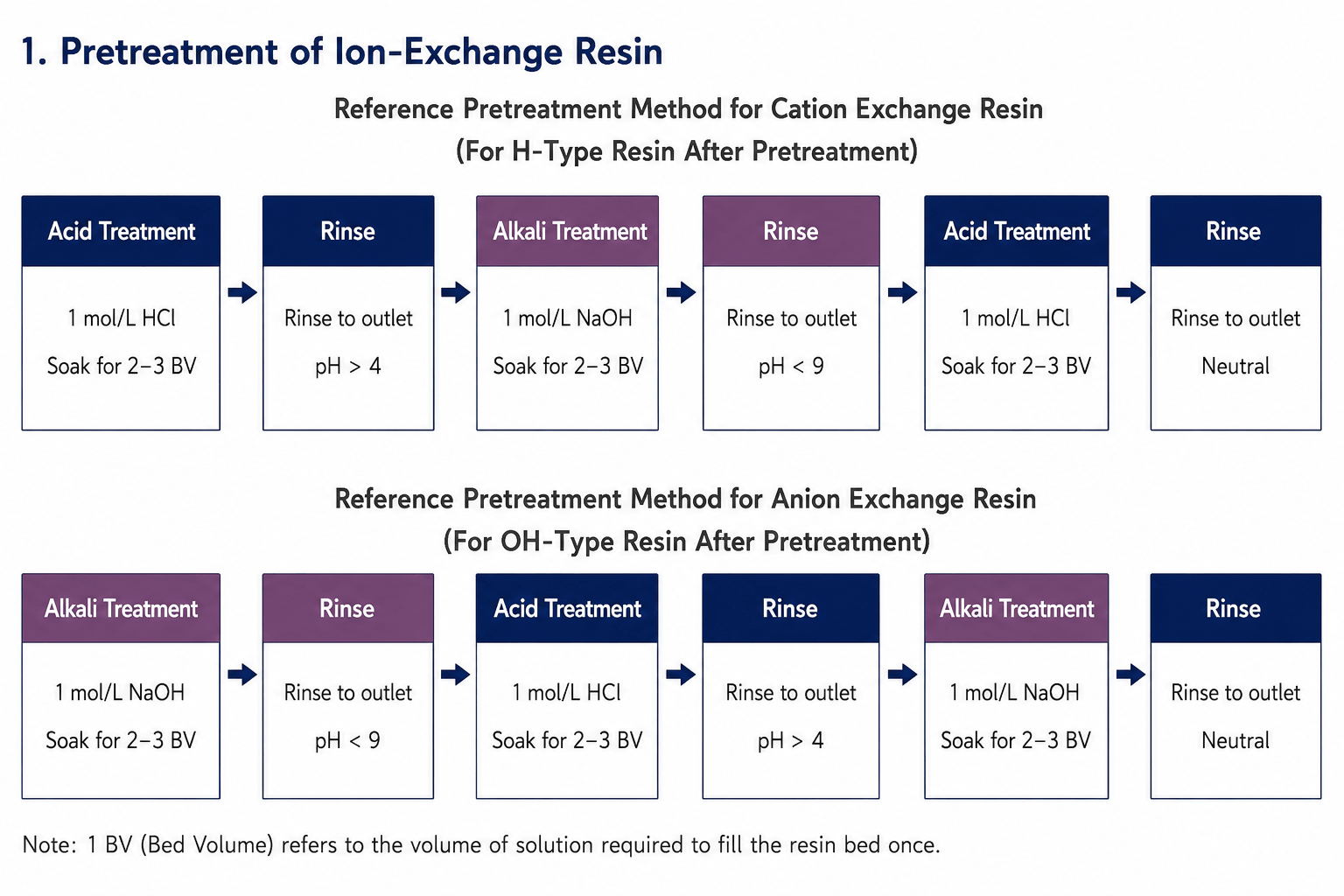
Pretreatment Steps for Strongly Acidic Cation Exchange Resin (H)
Strongly acidic cation resins are the most widely used type of cation resin in water treatment. The standard pretreatment employs an alternating "acid-alkali-acid" process, interspersed with fresh water rinses after each step, totaling six operational steps. Specific parameters and process details are as follows:
Step 1: Hydrochloric Acid Pretreatment
Prepare a 1 mol/L hydrochloric acid solution with a volume 2–3 times that of the resin bed, and pass it slowly through the resin layer at an appropriate flow rate.
The primary purpose of this step is to dissolve metallic impurities within the resin and convert the resin's functional groups from the sodium form to the hydrogen form. The contact time between the hydrochloric acid and the resin should be at least 30 minutes; an excessive flow rate can lead to incomplete reaction and compromise the conversion efficiency.
Step 2: Initial Fresh Water Rinse
Rinse the resin from top to bottom using purified water or compliant softened water. Monitor the pH of the effluent continuously and stop rinsing once the pH exceeds 4.
This step aims to wash away residual hydrochloric acid from the resin layer. This prevents a neutralization reaction between the residual acid and the subsequently added alkali—which could generate significant heat and damage the resin—while also removing impurities dissolved by the acid.
Step 3: Sodium Hydroxide Treatment
Prepare a 1 mol/L sodium hydroxide solution with a volume 2–3 times that of the resin bed, and pass it through the resin layer at the same flow rate used for the acid wash.
Those new to the process may wonder why a cation resin—which is intended to be converted to the hydrogen form—undergoes an alkali treatment. In reality, certain organic impurities and oligomers within the resin are difficult to remove under acidic conditions but are more easily eluted in an alkaline environment. Alternating acid and alkali treatments ensures that different types of impurities are addressed, achieving thorough cleaning.
Step 4: Secondary Fresh Water Rinse
Continue rinsing the resin until the effluent pH drops below 9; the process can then be concluded.
Following the alkali treatment, the resin temporarily converts to the sodium form. Therefore, the goal of this rinse is not to achieve a neutral pH, but simply to wash away the majority of the residual alkaline solution, as a secondary acid conversion step will follow.
Step 5: Final hydrochloric acid conversion treatment
Pour in 1 mol/L hydrochloric acid solution again, using 2-3 times the bed volume to ensure sufficient contact and reaction between the resin and the acid solution.
This step aims to fully convert the resin (which reverted to the sodium form after alkali treatment) back to the hydrogen form, ensuring the final functional group state meets operational requirements. Sufficient acid concentration and volume must be ensured; otherwise, incomplete conversion will directly impact subsequent exchange capacity.
Step 6: Final Pure Water Rinse
Continuously rinse the resin bed until the effluent pH approaches neutrality and the effluent conductivity stabilizes without significant rise. Once rinsing is complete, the pretreatment of the hydrogen-form strong acid cation resin is finished, and it is ready for immediate operation.
Pretreatment Steps For Anion Exchange Resin (OH)
The pretreatment logic for anion resin is the exact opposite of that for cation resin; an "alkali–acid–alkali" process is employed. The core objective is to completely convert the resin to the hydroxide form while removing internal organic and metallic impurities. There are six standard operating steps, detailed below:
Step 1: Sodium Hydroxide Pretreatment
Prepare a 1 mol/L sodium hydroxide solution (using a volume 2–3 times that of the resin bed) and pass it slowly through the resin bed at an appropriate flow rate.
This step converts the resin from its as-supplied chloride form to the hydroxide form; simultaneously, the alkaline environment effectively leaches out impurities such as organic residues and oligomers. Since anion resins are more susceptible to organic fouling, the contact time for this step may be extended to enhance cleaning effectiveness.
Step 2: Initial Water Rinse
Rinse the resin bed with pure water in a down-flow manner and monitor the effluent pH; stop rinsing once the value drops below 9.
The purpose of this rinse is to remove residual alkali—preventing a violent neutralization reaction during the subsequent acid addition—and to wash away organic impurities leached out by the alkali.
Step 3: Hydrochloric Acid Wash
Pass 1 mol/L hydrochloric acid solution through the bed (using a volume 2–3 times that of the resin bed) while maintaining the same flow rate used in the preceding alkali wash. Acid treatment serves to remove metallic impurities and residues that are difficult to elute under alkaline conditions, thereby further cleaning the resin's internal pores. Following this step, the resin is temporarily converted to the chloride form.
Step 4: Second Water Rinse
Continue rinsing the resin until the pH of the effluent exceeds 4.
It is not necessary to rinse until neutrality is reached; the goal is simply to wash away the bulk of the hydrochloric acid and reduce reagent consumption during the subsequent alkali treatment.
Step 5: Final Conversion With Sodium Hydroxide
Pass 2–3 bed volumes of 1 mol/L sodium hydroxide solution through the resin again, ensuring thorough contact and reaction between the solution and the resin.
This is the core stage of the anion resin pretreatment process; sufficient alkali must be used to completely convert the resin from the chloride form to the hydroxide form, thereby restoring its full anion exchange capacity.
Step 6: Final Rinse With Purified Water
Continue rinsing the resin bed until the effluent pH approaches neutrality and the effluent conductivity stabilizes. Once rinsing is complete, the pretreatment of the hydroxide-form anion resin is finished, and the resin is ready for operational use.
Key Parameters Affecting Resin Pretreatment Effectiveness
The effectiveness of pretreatment depends on more than just the correct process flow; the control of several core parameters directly determines the final state of the resin.
Reagent Concentration
The industry-standard concentrations for hydrochloric acid and sodium hydroxide are 1 mol/L, which translates to mass fractions of approximately 4% for hydrochloric acid and 4% for sodium hydroxide. If the concentration is too low, the rates of impurity leaching and resin conversion slow down; a larger volume of reagent is required to achieve the same result, leading to low processing efficiency. Conversely, excessively high concentrations increase costs and may damage the functional groups of weak-type resins or even compromise the resin's skeletal structure. For weak-acid or weak-base resins, the reagent concentration for pretreatment must be appropriately reduced; parameters used for strong-type resins cannot be applied directly.
Treatment Volume (BV)
Here, BV refers to the bed volume—the volume of the resin after natural packing. The dosage of the acidic or alkaline pretreatment solution is typically controlled at 2 to 3 times the bed volume. This range is selected because the solution continuously reacts with the resin as it flows through the resin bed, causing the concentration to gradually decrease. A volume of 2 to 3 BV ensures that the entire resin bed comes into sufficient contact with the reagent at an effective concentration to complete conversion and impurity removal. Dosages of less than 2 BV risk incomplete conversion of the resin at the bottom of the bed, while exceeding 3 BV yields negligible improvements and merely wastes reagents and time.
Control of the Water-Washing Endpoint
Water washing should not be stopped based merely on an estimated duration; the pH value of the effluent must serve as the criterion. Insufficient washing leaves residual acid or alkali that carries over into subsequent operational stages, directly affecting initial water quality. It may also interfere with downstream units—such as mixed beds or polishing resins—preventing the system from meeting design effluent specifications for an extended period. Strict control of the water-washing endpoint is particularly critical for ultrapure water systems that demand high water quality.
Differences in Resin Types
Strong-acid cation resins and strong-base anion resins possess high tolerance to acids and alkalis and can be treated using the standard 1 mol/L concentration. Weak-acid cation exchange resins and weak-base anion exchange resins have relatively lower functional group stability; therefore, during pretreatment, it is necessary to reduce reagent concentrations and shorten contact times to avoid functional group degradation caused by over-treatment. If parameters are uncertain, prioritize the technical manual provided by the resin manufacturer.
Common Issues and Solutions During Pretreatment
In actual operations, anomalies often arise, usually due to inadequate parameter control.
Effluent Conductivity Remains High After Rinsing
This is the most common issue and is almost always caused by insufficient rinsing. Residual acid or alkali solutions can remain in the gaps between resin beads and within internal pores; if the rinse flow rate or duration is inadequate, these residual chemicals release slowly, preventing the conductivity from dropping. The solution is straightforward: appropriately increase the rinse flow rate and extend the rinsing time, or use a high-flow, short-duration rinse to flush out the residual chemicals from the gaps. Monitor conductivity periodically during the rinse until the value stabilizes and stops decreasing.
Low Exchange Capacity After Pretreatment
If the resin exhibits an operating exchange capacity significantly lower than the design value after being loaded into the column and put into operation, the conversion process was likely incomplete. Possible causes include insufficient reagent dosage or concentration, or an incorrect pretreatment sequence resulting in the wrong final resin form. In such cases, the conversion process can be repeated. Perform an additional hydrochloric acid treatment followed by rinsing for cation resins, and an additional sodium hydroxide treatment followed by rinsing for anion resins; ensuring reagent concentrations and dosages meet specifications usually restores normal capacity.
Rapid Performance Decline After Operation Begins
Some resins perform normally initially but show a significant drop in performance shortly after operation starts. There are two possible reasons for this: first, incomplete pretreatment, where residual impurities inside the resin are gradually released during operation, slowly clogging pores and masking functional groups; second, improper storage—such as dehydration and shrinkage, freezing, or exposure to direct sunlight—which damages the resin's internal structure. If residual impurities are the cause, a thorough "deep cleaning" with acid and alkali can be performed; if the resin structure itself is damaged, there is no effective repair method, and resin replacement is the only option.
Application Scenarios for Properly Pretreated Resins
Ion exchange resins that have undergone proper pretreatment deliver consistent performance as designed and are suitable for a wide range of water treatment applications.
Industrial pure water production is the most common application. By treating process water and cleaning water with a combination of cation and anion resins, the vast majority of dissolved salts can be removed, meeting basic production water quality requirements. Resins that have been thoroughly pretreated offer stable operating cycles and more predictable regeneration frequencies.
Boiler feedwater treatment demands extremely low hardness levels. Cation resins remove calcium and magnesium ions from the water, preventing scale formation inside the boiler. Inadequate resin pretreatment allows for the gradual release of metal impurities, leading to fluctuations in effluent hardness and increasing the long-term risk of boiler scaling and corrosion.
Demineralized water and ultrapure water systems impose even stricter requirements on resins. Ultrapure water for the electronics industry, for instance, requires a resistivity of 18.2 MΩ·cm and controls TOC and metal ion levels at the ppb (parts per billion) range. If resin pretreatment is substandard, trace residual impurities will continue to leach out, making it impossible to meet ultrapure water quality standards.
Water treatment in the pharmaceutical and food industries must comply with relevant sanitary regulations in addition to meeting water quality parameters. Pretreatment removes organic residues from the resins and lowers the TOC of the product water, thereby preventing adverse effects on product quality and ensuring compliance with pharmacopoeia and industry standards.
Practical Recommendations for Resin Pretreatment
Pretreatment of ion-exchange resins is not an optional step but a fundamental requirement for ensuring long-term, stable resin performance.
Proper acid-base conversion is essential for the resin to achieve its rated exchange capacity. Skipping pretreatment or simplifying the steps—while seemingly saving time and chemicals—actually leads to shorter operating cycles and poor effluent quality, ultimately increasing subsequent operating costs.
In practice, there is no need to blindly pursue higher chemical concentrations or excessive treatment volumes; excellent pretreatment results can be achieved by adhering to standard dosages (2–3 BV) and concentrations (1 mol/L) while strictly monitoring the pH endpoint during each rinsing step. For special weak-functionality resins or specialty resins, prioritize the manufacturer's pretreatment guidelines rather than simply applying parameters intended for strong-functionality resins.
Proper pretreatment not only ensures stable and compliant exchange performance but also minimizes operational malfunctions and effectively extends the resin's overall service life.
Note: The pretreatment methods described above for anion/cation exchange resins and macroporous adsorption resins are standard procedures provided for reference only. Treatment requirements and operational forms may vary depending on the specific resin model and application conditions; therefore, pretreatment methods should be tailored to specific circumstances. Users are encouraged to consult us for further guidance.